CLASSICALLYPRACTICAL.COM

Ruminating on Remedies

Picture

Julia Coyte, CHom

My thoughts on a few of the many thousands
of homeopathic remedies available.
​Where, when and how they may be applied in everyday life.

#wellnessawaits

To subscribe to Ruminating on Remedies via Substack, click here. Thanks!
Note: My Substack subscription is free of charge.


Or, follow me on any of the following social media sites…

X/Twitter: @RemedyRuminator
Telegram:
 t.me/wellnessawaits
Facebook: @JuliaCoyteHomeopath
MeWe: mewe.com/i/juliacoyte
Gab: @Bobthepeacock​
Gett'r: Classically Practical Homeopathy @ jcoyte
Locals: https://rollinwithmyhomeys.locals.com
I use Substack to email my latest articles. To subscribe for free, click above or go to homeopathy.substack.com.

Picture
​Ruminating on Remedies: Digging Deeper 

​ Introducing in-depth homeopathic articles,
digging a little deeper into topics that take my fancy.
​
At this point in time, it is only available at homeopathy.substack.com but
I hope to have it available here in the near future!

Ruminating on Remedies is and always will be free.
Those articles are listed below.
​
Thanks for reading!!
  • Home
  • In a nutshell …
    • Classical? Practical?
  • About
    • contact >
      • FAQ
  • Blog
  • Book appt
    • Before first appt >
      • Choosing a homeopath
      • Useful info >
        • References & Resources
  • Research
  • Product

7/25/2026

Book Review: "Homeopathy: Harnessing Nature's Pharmacy"

Read Now
 
​First off, let me tell you that I am an absolute sucker for a little book. Make it hardcover and I’m hooked even more. Gild the edges and you have me judging a book by its cover and I’m in love with it!
Picture
As I write this on my laptop, the image of the cover is actually bigger than the book itself. It appears this book is part of a series of little hardcovers (Sirius Hidden Knowledge*). ISBN: 978-1-3988-4465-0/$12.99
Emma Van Hinsbergh** (2024) wrote this very pleasing little book. It’s like those lovely little books that are on display in the bookstores around Mother’s Day or Christmas. A perfect little gift.

All the pages are illustrated with a gentle shade of green. The introduction says, “By using this book as a handy tool to delve more deeply into this fascinating healing system, you can learn how to improve your mind, body and soul. From getting a better night’s sleep to boosting your immune system, homeopathy can set you on the road to a healthier, happier life.”

Chapter 1: A Gentle Healing Tradition, explains the history and principles of homeopathy.

Chapter 2: Why Choose Homeopathy? The author explains how “homeopathy is often sought for chronic conditions, where conventional medicine might not help in providing long-term relief. It aims to stimulate the body’s natural healing abilities, addressing the root cause of the imbalance and promoting overall well-being.” She lists a couple of pages of the benefits of using homeopathy (gentle, individualized, safe) and gives a little case study showing how homeopathy was “absolutely life changing” for one teenager.

Chapter 3: Your Health explains how homeopathic remedies are made, what to expect during a homeopathic consultation and ten helpful questions to ask a potential homeopath.

Chapter 4: Daily Healing begins by explaining how to use homeopathy at home, followed by materia medica of few remedies and remedies one might want to include in a homeopathic home kit and then a few remedies for some mental/emotional symptoms and rounds out the chapter with a very quick description of the top 50 homeopathic remedies.

Chapter 5: Be Your Own Homeopath tells you how to do just that — how to match the symptoms and choose the best remedy and potency. This is the bulk of the book — a mini (and pretty) homeopathic handbook. This chapter ends with a very short list of common conditions and possible remedies.

The acknowledgements page thanks the team at Homeopathy UK (“the UK’s leading charity for the promotion of homeopathy”) and lists a few websites to get you on your way to your next step in using homeopathy.

In short, this little book is an excellent gift for the homeocurious person in your life. The idea of homeopathy can be a hard sell for a lot of people. This book is a non-threatening (welcoming even!) introduction for homeopathy newbies.


Julia Coyte, CHom

Classically Practical homeopath


#wellnessawaits


*ABOUT THE SERIES: Sirius Hidden Knowledge Series explores some of the most fascinating subjects in modern alternative thought and practice. Written by experts and renowned practitioners in their respective fields, this series brings the latest in developments in everything from spiritual development to alternative health. These delightful hardback editions are presented with gold embossed cover designs and gilded page edges.”
​

**Emma Van Hinsbergh is not a homeopath, according to the page cited above. She is a reporter/editor, specializing in health and wellbeing. Not that it matters, I’m just dotting is and crossing ts. In fact, this might be a selling point of the book - it is truly written for the absolute homeopathic greenhorn.

Share

1/31/2026

Potency Books, part 1

Read Now
 
Picture
A quickie look at what is in each of these books.

Margriet Plouvier-Suijs’ About Potencies
  • It says in the forward: “Suijs has created an extremely workable overview of the functioning of different potencies by systematically and logically arranging her observations of the therapeutic effect after prescription. This is a great support when we try to choose the appropriate potency for a case.”
  • She then works through the potencies. For example, she begins with the heading, “3x-6x, 3c, 4c” and talks about the effects of these low potencies (they have a stimulating effect) and how they are used in organotherapy.
  • For each potency group, we learn “characteristic words or language related to these potencies” and then followed by various cases which follow each characteristic word.
    • she provides the words for 9c, but says, “Unfortunately I have no example…” fortunately for us, the rest of her sections do have examples.
  • She also, interestingly, equates C/K potencies to LM potencies.
  • This book is unlike any other I have used and though it has been sitting on my shelf for a long time, mostly unread, I am going to be digging in a little more frequently from now on.

Select your Dose and Potency by Dr. P.S. Rawat
  • I found the introduction to be the most useful — it’s short, but full of information.
  • The bulk of the book is a list of homeopathic remedies and which historical homeopaths (denoted by initials) used which potency, plus any notes of relevance. Sometimes a potency is tied to a specific condition, but more often not. For example, Eupatorium perforliatum says: “1. Tincture, to third attenuation (WB). 2. 20th and 200th potencies are generally used. 3. Bears repetition well (KNM). 4. Allen recommends it to be applied locally in sore nipple and sore mouth.” This entry continues through number 12, and I won’t be putting it all here, but I wanted to give a flavor of the book.
  • Some entries are much more fleshed out and more useful than others. Magnesia Phosphorica, for example, goes on for a couple of pages, with 35 entries, most with specific uses and potencies.
    • Irksome, but not a big deal: not all the initials line up with the abbreviation list. The first entry for Abies Canadensis attributes point 1 to (WB) and point 5 to (BW). However, in the list, BW = A.C. Blackwood but there is no WB. There is a WKB (W.K. Bond), but we can only assume this is the same as WB.

The Potency: Advanced Prescribing in Homeopathy by Dr. Joe Rozencwajg (I have more coming soon using this book)
  • Dr. Rozencwajg begins this book talking about various methods of potency, but what it is mostly about is the Fibonacci Potencies: “a unified theory and practice of modern homeopathic posology.”
  • I have not completed this book yet, but I look forward to learning this system. So intriguing! But, this is not what my upcoming article is about.

Michelle Shine’s What About the Potency: (A Comprehensive Guide to Homeopathic Potency and Dosage)
  • I found this book the most helpful out of the four for my purposes. The first half of the book is a series of the author’s cases and what happened with each. Interspersed are short write-ups of various topics, such as:
    • the constitutional remedy v prescribing for the disease
    • what is homeopathic potency
    • changing potency
    • depths and layers
    • plussing remedies
  • The second half of the book (and what I found most interesting) are transcripts of her interviews with 10 well-know homeopaths and their thoughts on potency selection.
    • Mike Bridger, Ian Watson, Jeremy Sherr and others

Happy Reading!

Julia Coyte, CHom
Classically Practical homeopath


#wellnessawaits


Share

1/10/2025

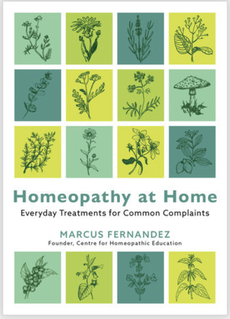
Book Review: Homeopathy at Home: Everyday Treatments for Common Complaints

0 Comments

Read Now
 
Picture
My copy of Homeopathy at Home: Everyday Treatments for Common Complaints by Marcus Fernandez has arrived and it is every bit as good as I expected! (See here and here for a little about Marcus.)

Let me begin by saying how much I enjoyed his introduction. Following his own story of finding homeopathy (I love to hear how people have found their way to homeopathy! -- see below), he states: 
“My aim is to enhance the health and wellbeing of humankind through the use of homeopathy.” What a wonderful goal! 

He continues: “I wanted to write a simple and accessible guide to managing common acute and minor complaints using homeopathic remedies at home. I want people to feel empowered. We all have innate health. Homeopathic remedies act like keys to a lock — choose the correct key and it turns the lock, stimulating the body to heal itself. It’s good to remember that the body has a natural healing wisdom; we just need to turn the key and remind it what it needs to do.” I told you I enjoyed reading his introduction!

What follows is a simply organized A-Z list of common complaints with a page or so describing each condition suggesting possible causations, as well as some “actions that might help” to relieve symptoms. Then, a nice selection of (mostly) commonly available remedies to choose from with clearly written descriptions of each to help the reader differentiate between them. This book is just what the beginning homeopath/mom/family/student needs in their life!

In addition to his well chosen homeopathic remedies for each symptom, he also offers suggestions for other home remedy ideas. For instance, since we’re in the middle of the flu season, he suggests a couple of lovely sounding drink blends to soothe sore throats and reduce inflammation.

If you are ready to take the next step in helping yourself and your families, Homeopathy at Home is the perfect place to start.

But wait, there’s more!

I have a copy to give away. Write in the comments below how you were introduced to homeopathy and I will put those names in a hat and choose one commenter at random and ship the book to you, free of charge.
(I will be picking the name at random on 1/16/25.)


Julia Coyte, CHom
Classically Practical homeopath


#wellnessawaits


* I have no affiliation with Marcus Fernandez or this book. I’m just a big fan!

Share

0 Comments

12/2/2023

Book Review: The Homeopath in Your Hand

Read Now
 
The Homeopath in Your Hand by Lisa Strbac

The Homeopath in Your Hand is a brand new book that I did not realize was missing from the world of homeopathic books!

In just a few short pages at the beginning of this book, homeopath Lisa Strbac gives a short, (but nice!) overview of the basics of homeopathy: symptoms; the history of homeopathy and the theory behind it; how remedies are made; potency; how to choose remedies and specifically how to choose remedies based on her own HEALS™ technique.

HEALS™ stands for:
    Helps or Hinders
    E for Event
    A for Accompanying symptoms
    L for Location
    S for Sensations

Following this, she has a couple pages on how to dose the remedies and some frequently asked questions to round out the introduction.

Then, we get to the good stuff. Lisa has a 2-page spread for 77 common remedies, making for a very handy household materia medica.

At the top of each page is the name of the remedy with one quick line to sum up the remedy. On the left hand side, she lists the key symptoms and some fun little graphics that I find very helpful in getting to the remedy you need quickly. At the bottom of the page are her Hindered/Helped by symptoms (what homeopaths refer to as modalities -- what makes the person better or worse).

Picture
Picture
​The Homeopath in Your Hand pages reprinted with permission from the author.
The right hand page provides a little more information on the remedy… the full name of the remedy, other names by which we may know the substance and where the substance may be found in nature. 
​
This materia medica is simple enough, (and, the pictures make it engaging enough!) to be useful for everybody, including children. If you are a homeschooling family learning to use homeopathy, this would be a terrific book to have around.

At the end of the book is a short list of “essential combination remedies” including:
  • ABC 
  • Injury mix (see here, here and here for previous articles on this combo)
  • various Narayani mixes

The final few pages are dedicated to symptoms, or, in homeopathic terms, a repertory. For each heading (e.g. Burns, Cramps, Headaches, Mastitis, Wounds) listing a handful of remedies which might be indicated.

The Homeopath in Your Hand is a great little book that I certainly wish I had when I was just starting out with homeopathy.

Stockists can be found on her website, or, better yet, ask your local bookseller to carry it: ISBN 978-1399964906. Also on her site, Lisa offers courses and you can even pre-order her exclusive remedy kit to accompany the book. Now that would be an amazing present for somebody this upcoming holiday season!


Julia Coyte, CHom
Classically Practical homeopath


#wellnessawaits

Share

12/8/2021

Book Review: Asteraceae

Read Now
 
“Those radiant flowers of the sun, plant of our central star: daisies, marigolds and chamomile have become vital remedies in homeoapthy. … The Asteraceae are remedies for ruptures of the mind and body, when boundaries have been broken by accident, violence, abuse or invasion. Invasion can take many forms, such as blood poisoning, parasitical worms, insect-borne diseases, viruses, bacterial infections or hay fever. But it can also mean injuries, surgery, physical and emotional abuse, or malevolent psychic invasion. … They are remedies for restoring a sense of wholeness and integrity to lives fragmented by trauma, and include some of the oldest plant medicines known to humanity.” ​
Picture
​Asteracea: remedies of the sunflower family ​by Jo Evans.

Asteracea by Jo Evans is a beautiful book full of stunning full-page color photos and illustrations of the various plants that make up this very large plant family including more than 23,000 species found everywhere except Antarctica (Funk et al. 2004).

This nicely sized tome is divided into two parts. Part 1 is Plant Portraits: 35 photographic portraits opposite full-page descriptions of plants as homeopathic remedies, along with a small box at the top of each page with some key notes as well as botanical details and its traditional uses.

The quick overview of Echinacea angustifolia describes this pink coneflower as a good homeopathic remedy for “Post-viral fatigue syndrome. Coughs, cold, flu. Blood poisoning. Bites, stings, boils. Acute illness that becomes chronic.” [gosh. This sounds like it could be a useful remedy these days!] Echinacea was “originally known as a medicine for blood poisoning and septic states” and primarily acts "on the blood, lymph and lungs" and "has become known as the herbal antibiotic.” Noting various other plants containing cichoric acid “which has been found to have strong anti-viral properties”  (Evans 2020, p. 29). 

Every page is simply stunning and the descriptions are short enough to keep the interest level high and full of enough information so that the reader gets an excellent understanding of each plant’s homeopathic benefits.

Part 2 provides us with a comparison of remedies, beginning with The Anthemideae, the aromatic herbs which are “some of the oldest medicines known” (Evans 2020, p. 75). Remedy themes and history are interwoven with differentiations and case studies.

A deeper dive into Millefolium comes next, followed by “Bitter Foods: Thistles and Lettuces,” a chapter which follows much the same structure as the Anthemideae section.

“Earthing the Sun: the alchemy of sunflowers.” Similar to the earlier sections, Evans gives us a comparison of remedies within themes. For instance: spleen and wound healing and fevers.

Calendula, Bellis perennis and Arnica each get their own well-deserved separate chapters. The final chapter is The Sundial, based on the remedy Espeletia grandiflora and is followed by a one-page overview of the Asteraceae themes.

This gorgeous book is well researched and heavily cited and worthy of many repeat readings. Though it is presented in a highly readable format, there is so much information contained in these pages it is impossible to absorb it all and thus deserves a prime spot on your shelf for the many return visits you will want to make to it.

Did I mention how beautiful this book is?

For more information, visit: Asteraceae.
​

Evans, J., 2020. Asteraceae: remedies of the sunflower family. Harlem, NL: Emryss.

Reference list
Funk, V. A., Chan, R., and Keeley, S. C., 2004. Insights into the evolution of the tribe Arctoteae (Compositae: subfamily Cichorioideae s.s.) using trnL-F , ndhF , and ITS. TAXON [online], 53 (3), 637–655.

Plant Portraits, 2021. Plant Portraits [online]. Plant Portraits. 

Share

11/11/2021

Homeopathy in Dystopia

Read Now
 
Picture
Dystopian fiction used to be one of my favorite genres… until 2020 happened and we found ourselves living in an actual dystopia! A few weeks ago, I decided it was time to return to normal and re-visit this type of fiction. 

One Second After by William R. Forstchen came to me via an enthusiastic recommendation and it turned out to be a well-written, plausible scenario of the after effects of an EMP (Electromagnetic Pulse) being dropped on the United States. The result? All electronics ceased functioning: no phones, no running water, no refrigeration, no cars. Supply lines stopped. Stores looted and emptied in the first days. Medical help was dependent on the knowledge of the local doctors, nurses and veterinarians and whatever supplies they happened to have on hand.

You know what was missing in this scenario? Somebody with some homeopathic knowledge! Homeopathy is an essential skill to have if you are living off the grid, whether by choice … or through a fictional EMP being dropped.

The main character got a life-threatening infection after cutting his hand.  A number of remedies come to mind for a really bad infection*: Calendula (Parente et al. 2012; Givol et al. 2019; Preethi and Kuttan 2009), Gunpowder (Casey 2011) or, the  Banerji protocol of Hypericum 200c mixed with Arsenicum album 200c (Banerji and Banerji 2013). 

*This article is based on a fictional situation. If you find yourself in any of these situations in real life, seek medical attention immediately!

His daughter had Type 1 diabetes (NOT a good thing to have when the supply lines are cut and there is no more insulin to be found) and though homeopathy may help control some of the symptoms, it isn’t going to do much to help that situation. There are certainly medical conditions for which pharmaceutical drugs are absolutely necessary to keep people alive. But, this dystopian novel made me think about all the people dependent on pharmaceutical meds for non-life-threatening conditions. You don’t want to be dependent on these things when this fictional EMP is dropped (or even if there is a breakdown of the supply chain)!

The coming to grips with their new reality? Ignatia could certainly help with that. It is so good at addressing emotional shocks and for those suffering ill effects from hearing bad news or from fright and "disorders of the mind, particularly if actuated by grief, sadness, hopelessness, hysterical variableness, fantastic illusions" (Murphy 2006, p. 973).

The diarrhea that spread through town? Arsenicum album (Rafferty and Kayne 1994), Veratrum album (Banerji and Banerji 2013) or Camphor ​(Banerji and Banerji 2013; Leary 1997; Perko 2005). [An interesting read on the use of homeopathy in cholera epidemics.]

The psychiatric patients in town who no longer had their meds… Homeopathy has a good track record for helping mental and emotional conditions of all sorts and certainly could have helped to keep some of these conditions at bay, but these are better suited to an individualized classical homeopathic remedy. (Check out Homeopathy and Mental Health Care by C. K. Johannes for a place to start.)

Another beautiful aspect of homeopathy is it doesn’t require much of a supply chain. It is completely possible to make your own homeopathic remedies as long as you have either the raw materials or the homeopathic remedy itself. If you have blank pellets, you can create more pellets as needed, or, you can make essentially limitless liquid remedies from a couple of pellets and treat the whole town at once!

What else could these people have used? A good First Aid Kit** and the knowledge of how to use it.  When your local hospitals and clinics are no longer of any use to you, a medium-sized accident can leave you in a world of hurt. Remember, in this fictional account, there was no electricity, no internet, no phones to help you figure out how to use your first aid kit. It does you no good to have something downloaded on your now defunct tablet; you need to have good, old-fashioned books to guide you, like US Army First Aid Manual or Herbal medic : a green beret’s guide to emergency medical preparedness and natural first aid.

I know some people find these catastrophic topics disturbing. I like the problem solving that comes along with reading these kinds of books; to think about the worst case scenario and figure out ways to tackle the problems — being prepared (in my mind, at least) brings me a sense of calm.

I’m happy to have this genre back in my life. I wonder what the next dystopian scenario coming my way will be? Regardless of what it is, I bet homeopathy would be a useful skill to have!


Julia Coyte, CHom
Classically Practical homeopath

#wellnessawaits

** I have no affiliation with this company or any products listed here, I just like their products.

Picture
‌​​Forstchen, W. R., 2009. One Second After : John Matherson, Book 1. New York: Forge.

REFERENCES

Anon., 2020. Instructions For Turning Pills Into Liquid Remedies [online]. Homeopathy Plus. 

Banerji, P. and Banerji, P., 2013. The Banerji protocols : a new method of treatment with homeopathic medicines. India: Pratip Banerji.
‌
Camerlink, I., Ellinger, L., Bakker, E. J., and Lantinga, E. A., 2010. Homeopathy as replacement to antibiotics in the case of Escherichia coli diarrhoea in neonatal piglets. Homeopathy [online], 99 (1), 57–62.
‌
Casey, S., 2011. Gunpowder! Little-Known Remedy Packs a Wallop Against Wounds - Shirley Casey [online]. Hpathy. 

Coyte, J., 2021. Homeopathic potency briefly explained [online]. CLASSICALLYPRACTICAL.COM. 

Givol, O., Kornhaber, R., Visentin, D., Cleary, M., Haik, J., and Harats, M., 2019. A systematic review of Calendula officinalis extract for wound healing. Wound Repair and Regeneration [online], 27 (5), 548–561.

Jacobs, J., Jiménez, L. M., Gloyd, S. S., Gale, J. L., and Crothers, D., 1994. Treatment of acute childhood diarrhea with homeopathic medicine: a randomized clinical trial in Nicaragua. Pediatrics [online], 93 (5), 719–725.

Johannes, C. K., 2010. Homeopathy and Mental Health Care. The Netherlands: Homeolinks Publishers.

Leary, B., 1997. The homoepathic management of cholera in the nineteenty century with special reference to the epidemic in London, 1854. Medizin, Gesellschaft, Und Geschichte: Jahrbuch Des Instituts Fur Geschichte Der Medizin Der Robert Bosch Stiftung [online], 16, 125–144.
‌
Murphy, R., 2006. Nature’s materia medica : 1,400 homeopathic and herbal remedies. Blackburg, Va.: Lotus Health Institute, November.

Parente, L. M. L., Lino Júnior, R. de S., Tresvenzol, L. M. F., Vinaud, M. C., de Paula, J. R., and Paulo, N. M., 2012. Wound Healing and Anti-Inflammatory Effect in Animal Models of Calendula officinalis L. Growing in Brazil [online]. Evidence-Based Complementary and Alternative Medicine. 

Perko, S. J., 2005. The homeopathic treatment of influenza : surviving influenza epidemics and pandemics past, present and future with homeopathy. San Antonio, Tx: Benchmark Homeopathic Publications.

Preethi, K. C. and Kuttan, R., 2009. Wound healing activity of flower extract of Calendula offlcinalis. Journal of Basic and Clinical Physiology and Pharmacology[online], 20 (1).

Rafferty, A. and Kayne, S., 1994. The use of Arsenicum album 30c to complement conventional treatment of neonatal diarrhoea (“scours”) in calves. British Homeopathic Journal [online], 83 (04), 202–204.
‌

FIRST AID BOOKS

Coffman, S., 2021. Herbal medic : a green beret’s guide to emergency medical preparedness and natural first aid. North Adams, Ma: Storey Publishing.
‌
Pareek, R. S. and Pareek, A., 2012. Homeopathy for Acutes and Emergencies. Kandern, Germany: Narayana Publishers.

Ratera, Dr. M. M., 2016. First Aid with Homeopathy.

Schmukler, A. V., 2006. Homeopathy : an A to Z home handbook. Woodbury, Minn.: Llewellyn Publications.
​
United States. Department Of The Army, 2009. U.S. Army first aid manual. New York: Skyhorse Pub.

Wiseman, J. and Britain., G., 2014. SAS survival handbook : the ultimate guide to surviving anywhere. New York: William Morrow, An Imprint Of Harpercollins Publishers.
‌

Share

9/21/2021

Minuteness

0 Comments

Read Now
 
Picture
Shephard, Dr. D., 1989. The magic of the minimum dose : experiences and cases. Saffron Walden: Health Science Press.

Widely available in printed form as well as e-book or PDF downloads.
I’m going to take just a moment of your time to share Dr. Dorothy Shepherd’s thoughts, word for word from her book, Magic of the Minimum Dose (first published in 1938). She makes an important point about minuteness. Very good food for thought for the skeptics amongst us.

​
“He found in fact that the lesser became the greater. A vital and most important truth.… ‘Can this be possible?’ you say. To the man steeped in materialism, this seems foolish to say the least; the lesser cannot be the greater. And yet this same man, this same doctor who laughs at the possibility of being able to cure with doses one millionth of a grain, or even a smaller quantity, this doctor shakes in his shoes at the thought of smallpox and passes on his fears to all the rest of credulous mankind. At the mere breath of the word smallpox, all rush off to be vaccinated as a preventative, even though smallpox may be miles away at the other end of the county. And the causative agent of small pox is a virus, an agent so small that even the strongest lenses of the most powerful microscope cannot make it visible*; it is an invisible ultramicroscopic organic cell. Do you understand what that means? A bacillus which shows up moderately plainly in a microscope, is so small that it would take 400 millions of bacilli, lying side by side, to cover an ordinary postage stamp. And a virus is infinitely smaller than one bacillus. The doctors are afraid of smallpox and so is every sensible person, and with reason; for a severe case of smallpox is a truly awful spectacle and extremely fatal as well. And is not everybody scared of diphtheria, of the minute bacillus causing this disease, so deadly to so many children, which is prevalent everywhere; all the health officials rush about and are so busy getting everybody protected against it, they do not laugh or sneer at the minuteness of this organism; they have felt the power of these minute germs. Yes, they are all disease-minded, they fear diseases and their causes, the minutest cells. But they do not follow up this argument to its logical conclusion; if the infinitesimal organism has so much power for evil, why cannot an infinitesimal quantity of a drug have as much power for good? [emphasis added]
​
… there are viruses causing disease in animals and others causing diseases in plants. We do not know how they act, but we are content to accept the fact that they do act and cause serious harm. And these same people who acknowledge the power inherent in these minutest of living forms, the viruses, will not recognize the radio-active power, the dynamic forces residing in and brought about by the special method of preparation of the potentised drugs [homeopathy]."

Magic of the Minimum Dose is a highly readable book retelling her experiences of treating patients during the war in England.

* this book was originally published in 1938


‌

Share

0 Comments

9/18/2021

Ammonium carbonicum

0 Comments

Read Now
 
Picture
I first learned about the homeopathic remedy Ammonium carbonicum when I was just beginning my adventure into the world of homeopathy. It was taught to me as part of a Banerji Protocol for menopausal symptoms: Brainfog, moodiness & irritability and abnormal menstrual bleeding. (See bottom of article for the Banerji Protocol.)

I next stumbled upon Ammonium carbonicum when I had flu-like symptoms. I remember the headache very well. It was like I had eaten ice cream too fast except time was not helping the pain to go away. I was thumbing through a book that had been sitting on the shelf, waiting for this very moment to prove its usefulness. The Homeopathic Treatment of Influenza: Surviving Influenza Pandemics Past, Present and Future with Homeopathy by Sandra J. Perko. This book has since earned a prized location on my bookshelf.

Headache Symptoms: Am-c (Ammonium carbonicum): 
Headache with fever. Headache centered in the forehead at the root of the nose. Headache with nausea. Better with pressure and in a warm room (Perko, 2005, p. 211).


This description was by far the closest listed for my headache that day, though the words alone didn’t fully describe the pain I was experiencing. When I learned that Ammonium carbonicum is a homeopathic remedy made from smelling salts, that’s when the penny really dropped. If you have ever had a good whiff of ammonia, you know where that odor concentrates — right at the root of the nose — right where an ice cream headache settles in.

I took one dose of homeopathic Ammonium carbonicum 200c and I was on my way back to engaging with the world.

Perko’s book is formatted in such a way that even if it is you who is trying to figure out the best remedy for yourself when you’re feeling rotten, it is totally do-able. Following interesting information about influenzas throughout history (which you can marvel at later, when you’re feeling better), page 138 jumps right in with Predominating Symptoms: “Fever Predominates: High Temperature - Severe Sweating” and lists 54 short descriptions of homeopathic remedies and the types of fever symptoms they address. 

There are not chapters, per se, but headings: Fever, Perspiration, Chill, Respiratory symptoms, Catarrhal (mucus) symptoms, Cough, Throat, Larynx, Tongue & Mouth symptoms, Nasal, Sneezing, Eyes, Musculoskeletal, Headache & Face symptoms, and Vertigo. Each subheading is followed by dozens of 2-4 line entries of clear symptomatic descriptions of each homeopathic remedy as it relates to the specific Predominating Symptom.

Following the Predominating Symptoms is the “Influenza Differential Reference” listing the remedies and how they each relate to the flu. Unlike most Materia Medicas, this one first lists “Influenza Keynotes” and then provides a paragraph from noted homeopaths (current and historic) and their thoughts on each homeopathic remedy in regard to its connection to influenza. 

The end of the book closes out with a section on “Complications of Influenza” and homeopathic remedies which may help and also includes a special Bird Flu section.

You may now be wondering how menopausal symptoms relate to a remedy for an ice cream headache. Good question. Most homeopathic remedies relate to all/most parts of the body in their individual ways.*

Let’s look at Ammonium carbonicum on a very surface level and think back to the old movies and novels where we would see women of a certain age taking a little whiff of their smelling salts. 

We learn in Tasca’s article, (2012) Women and Hysteria in the History of Mental Health that “During the Victorian Age (1837-1901) most women carried a bottle of smelling salts in their handbag: they were inclined to swoon when their emotions were aroused, and it was believed, that, as postulated by Hipocrates [sic], the wandering womb disliked the pungent odor and would return to its place, allowing the woman to recover her consciousness.”

​I posit that it wasn’t the “wandering womb” that was causing the problems and nor were her problems to be considered "hysteria," but various menopausal symptoms were in play and that the smelling salts were helping to address.


Julia Coyte, CHom
Classicallypractical.com

#homeopathycanhelp  #wellnessawaits
Menopausal Syndrome, Banerji Protocol:
Menopausal symptoms, in general, including brain fog, moodiness & irritability as well as heavy menstrual bleeding:
Ammonium carbonicum 200, once every 10 days. 
​
Note: this is one part of the protocol and other remedies would be employed to address further menopausal symptoms such as hot flashes, racing heart, etc.

If you are experiencing a difficult time as a result of peri-menopause, menopause or post-menopause,
book an acute appointment now. 
* Keep an eye out for an upcoming article on homeopathic “provings” which will bring a little clarity on how we know how homeopathic remedies affect individuals. You can sign up to have the latest articles delivered to your email here.

Banerji, P. and Banerji, P. (2013). The Banerji protocols : a new method of treatment with homeopathic medicines. India: Pratip Banerji.
‌
Tasca, C. (2012). Women And Hysteria In The History Of Mental Health. Clinical Practice & Epidemiology in Mental Health, [online] 8(1), pp.110–119. Available at: https://www.ncbi.nlm.nih.gov/pmc/articles/PMC3480686/.
Picture
Perko, S.J. (2005). 
The homeopathic treatment of influenza : surviving influenza epidemics and pandemics past, present and future with homeopathy. San Antonio, Tx: Benchmark Homeopathic Publications.
Image borrowed from:
Anne Brontë. (2017). Smelling Salts: A Link Between Anne and Maria Bronte. [online] Available at: https://www.annebronte.org/2017/10/15/pass-me-the-salts-anne-and-maria-bronte/ [Accessed 11 Sep. 2021].

Share

0 Comments

7/14/2021

Book Review: Homeopathy: An A to Z Home Handbook

0 Comments

Read Now
 
Picture

Homeopathy: An A to Z Home Handbook by Alan V. Schmukler


This was my first book on homeopathy. All those years ago, this felt like a book of magic spells that I didn’t have the ability to access. I read through it many, many times. I turned down corners and marked up all sorts of pages. I may have even tried a remedy or two, but I’m thinking I probably didn’t. I was too nervous. It felt completely forbidden and a little scary.

In reality, it’s a straight forward book with good, useable information.

Maybe the introduction scared me off. Way back in 2006, Schmukler says, “I call this a handbook for survival, because in the coming years we may find ourselves in survival situations for the following reasons: 

1. Natural disasters
2. Terrorism
3. Antibiotic-resistant infections
[Where he writes, “The medical system could easily be overwhelmed by thousands of cases of untreatable infections.” That sounds familiar now that we have lived through 2020!]
4. Exotic diseases
5. Chemical or drug sensitivity
6. Genetic engineering
7. No medical insurance"

Maybe this list was too heavy for my relatively young and naïve self when I first found this book and homeopathy was completely foreign to me. I’ve made it to 2021 and am a little wiser to the ways of the world now. But, even before the nightmare of the last 18 months I had discovered the full importance of homeopathy in all these potential scenarios as well as every day life.

Chapter 1 is a nice explanation of homeopathy, why you would choose it, what it does and a brief history. Chapter 2 dives right into the rules for using the remedies and taking the case.
​
Chapter 3 starts the nitty gritty. Beginning with “Abscess” and closing out with “Yellow Fever,” he doesn’t quite make it all the way through the alphabet (that's because Zika wasn't widely known in 2006!) but the ailments he includes are meatier than other, similar books (as one might expect when one is writing a book for survival situations).

For each ailment he includes a brief description, followed immediately by a list of suggested remedies, each described in just a few lines. He keeps it simple and succinct. He also suggests a few starred remedies which are highly indicated for each condition.

Example from Homeopathy: Ailments A to Z, pages 198-199:
“Sprains
A sprain is an injury to the ligament around a joint. Symptoms include pain, swelling, and sometimes bruising.
* Arnica: Immediately after the injury.
* Rhus tox: Stiffness and pain, which is worse after rest and better from continued motion. Must keep shifting position.
Bryonia: Worse from any motion, better from pressure, better from lying on the affected part.
Ruta: Tendons, especially the ankle, heel and wrist. Repetitive motion syndrome. Worse after rest.
Hypericum: When nerves are damaged and there is much pain.”

You can’t get much clearer than those quick descriptions to get you on your way to healing.

Chapter 4 is a nice addition of “Organ Remedies” not often found in most “consumer” homeopathy books. Chapter 5 is “Remedy Description,” also known as a Materia Medica in homeopathy-speak.

“Pregnancy and Birth,” “Preventing Illness with Homeopathy,” “First Aid Remedies for Specific Occupations and Activities,” “Economizing: Making Your Remedies Last Forever” are chapters that definitely separate this book from its neighbors on the book shelf.

Schmukler rounds out the book with “Homeopathy Around the World” and “How to Use a Repertory” (which is basically a book of symptoms) and includes a mini-repertory. He finishes the book up with “Remedies for Your Home Kit,” which of course has a nod to some unusual remedies for when the survival situations get tough.

Schmukler, A.V. (2006). Homeopathy : an A to Z home handbook. Woodbury, Minn.: Llewellyn Publications.

Share

0 Comments
Details

    Archives

    October 2026
    September 2026
    August 2026
    July 2026
    June 2026
    May 2026
    April 2026
    March 2026
    February 2026
    January 2026
    December 2025
    November 2025
    October 2025
    September 2025
    August 2025
    July 2025
    June 2025
    May 2025
    April 2025
    March 2025
    February 2025
    January 2025
    December 2024
    November 2024
    October 2024
    September 2024
    July 2024
    June 2024
    May 2024
    April 2024
    March 2024
    February 2024
    January 2024
    December 2023
    November 2023
    October 2023
    September 2023
    August 2023
    July 2023
    June 2023
    May 2023
    April 2023
    March 2023
    February 2023
    January 2023
    December 2022
    November 2022
    October 2022
    September 2022
    August 2022
    July 2022
    June 2022
    May 2022
    April 2022
    March 2022
    February 2022
    January 2022
    December 2021
    November 2021
    October 2021
    September 2021
    August 2021
    July 2021

    Picture
    Julia Coyte is a classically trained homeopath who is well versed in the practical application of homeopathic remedies.
    ​
    To arrange for a consultation, click here.

    RSS Feed

    Categories

    All
    AAA
    Abrus Precatorius
    Abscess
    Abuse
    Accident
    Acetaminophen
    Ache
    Aches
    Acidity
    Acne
    Aconite
    Aconite Bryonia
    Aconitum Napellus
    Activated Charcoal
    Acupuncture
    Acute
    Acute Consultation
    Acute Sickness
    Advil
    Aesculus
    Aggravation
    Aging
    Ainsworth
    Air Sick
    Alcohol
    Allergic Reaction
    Allergies
    Allergy
    Allium Cepa
    Aloe
    Alopecia
    Altitude
    Alumina
    Alzheimer's Disease
    Ambra Grisea
    Ammonium Carbonicum
    Amputation
    Anacardium
    Anal Fissure
    Anal Fistulae
    Anaphylactic
    Anaphylaxis
    Anas Barbarie
    Anemia
    Anesthesia
    Anger
    Animals
    Ankle
    Annoyed
    Antacid
    Anticipatory Anxiety
    Antidote
    Antimonium Crud
    Antimonium Tart
    Anxiety
    Aphorism
    Aphthae
    Aphthous Stomatitis
    Apis
    Apis Mellifica
    Appendectomy
    Apps
    Aregentum Nitricum
    Argentum Nitricum
    Arnica
    Arsen
    Arsenicum Album
    Arthritis
    Aspen
    Asphyxia
    Asteraceae
    Asthma
    Aurum
    Aurum Metallicum
    Auto-immune
    Avena Sativa
    Azadirachta Indica
    Bach Flower Remedies
    Bach Rescue Remedy
    Back
    Back Ache
    Back To School
    Balance
    Bambusa
    Banerji Protocol
    Banerji Protocols
    Baptisia
    Baptisia Tinctoria
    Bashful
    Bedsore
    Bee
    Bee Sting
    Belladona
    Belladonna
    Bellis Perennis
    Betrayal
    BHI
    Bicycle Fall
    Bioplasma
    Bird Flu
    Bites
    Bite Tongue
    Blackhead
    Bleeding
    Bleeding Nose
    Blisters
    Bloating
    Blocked Eustachian Tubes
    Blood
    Blood Vessels
    Bloody Nose
    Body Aches
    Boils
    Boiron
    Boiron's Chestal Cold & Cough
    Bone
    Bone Spurs
    Boogers
    Book Review
    Books
    Borax
    Bordatella
    Bowel Habits
    Brain Fatigue
    Brain Fog
    Brainfog
    Breast Feeding
    Breathing
    Bristol Stool Form Scale
    Broken Bones
    Broken Heart
    Bronchitis
    Bruise
    Bruising
    Bryonia
    Bug Bites
    Bunions
    Burn
    Burning Eyes
    Burning Pains
    Burning Sensation
    Burning Urination
    Burns
    Burp
    Bursitis
    Caffeine
    Caladium
    Calc Carb
    Calc Fluor
    Calc Phos
    Calc Sulph
    Calendula
    Camphor
    Camphora
    Candy
    Canker Sore
    Canker Sores
    Cantharis
    Capsaicin
    Carbo Veg
    Carbo Vegetabilis
    Car Sick
    Cartilage
    Cataract
    Catarrh
    Caterpillar
    Cattle
    Causticum
    Cavities
    Cavity
    Cell Salt
    Cell Salts
    Centipede
    Cercarial Dermatitis
    Chamomilla
    Chapped Lips
    Charcoal
    Chelidonium
    Cherry Plum
    Chicken
    Chickens
    Chicory
    Chilblains
    Childbirth
    Children
    China
    China Officinalis
    Chiropractic
    Chlorine
    Chocolate
    Cholera
    Cimicifuga
    Cinchona
    Cinchona Officinales
    Claustrophobia
    Clematis
    Coca
    Cocculus
    Cocculus Indicus
    Coffea
    Coffea Cruda
    Coffee
    Cold
    Cold Calm
    Coldness
    Colds
    Cold Sores
    Cold Weather
    Colic
    Collagen
    Collapse
    College
    Collinsonia
    Colocynthis
    Combination
    Combination Remedies
    Comedone
    Comfrey
    Concentration
    Concussion
    Congestion
    Conium
    Conium Maculatum
    Conjunctivitis
    Connective Tissue
    Constipation
    Control
    Contusion
    Convalescence
    Convalescense
    Cookies
    Corneal Abrasion
    Coryza
    Cough
    Coughing
    Courage
    Covid
    Crab Apple
    Cracked Skin
    Cracks
    Cradle Cap
    Cramp
    Cramps
    Craniosacral Therapy
    Crotalus Horridus
    Croup
    Crush Injury
    Cst
    Cuprum Metallicum
    Cut
    Cuts
    Cystitis
    Dandelions
    Dandruff
    Daylight Savings Time
    Death
    Decongestant
    Dehydration
    Dementia
    Dental
    Dental Pain
    Dentist
    Dentistry
    Depression
    Diarrhea
    Digestive Supplements
    Dilution
    Dioscorea
    Disappointment
    Distraction
    Distrubed
    Dizziness
    Dizzy
    Dog
    Dogs
    Dorothy-shepherd
    Dose
    Dosing
    Dread
    Drosera
    Dry Mouth
    Dry Skin
    Dulcamara
    Dulcamera
    Ear Ache
    Ear Aches
    Ear Infection
    Ear Infection Research
    Ear Infections
    Ear Pain
    Ears
    Echinacea
    Eczema
    Edema
    Effort
    Elderly
    Elm
    Emergency
    Emotions
    Epistaxis
    Equisetum
    Eupatorium
    Eupatorium Perfolatum
    Eupatorium Perfoliatum
    Euphrasia
    Exams
    Excitement
    Exhaustion
    Exostosis
    Extravasation
    Eyeball
    Eyes
    Eye Strain
    Fainting
    Fall
    Falling
    Fart
    Fascia
    Fatigue
    Fear
    Ferr Phos
    Ferrum Phos
    Fever
    Fever Blisters
    Fibonacci
    Finger
    Fireworks
    First Aid
    First Aid Kit
    Flatulence
    Flatus
    Flu
    Flying
    Foodborne Illness
    Food Poisoning
    Foot
    Foot Cramp
    Foot Pain
    Forest Fire
    Fowl
    Fracture
    Frenectomy
    Fright
    Frostbite
    Frostnip
    Gallstones
    Ganglion Cysts
    Gas
    Gastro
    Gelsemium
    Gelsemium Sempervirens
    Gemmotherapy
    Geographic Tongue
    Glonoinum
    Graphites
    Grief
    Guilt
    Gunpowder
    Gut
    Hahnemann
    Hair Loss
    Hallucinations
    Hamamelis
    Hamamelis Virginiana
    Hamstring
    Hands
    Hangover
    Happiness
    Hay Fever
    Hayfever
    Head
    Headache
    Head Colds
    Head Injury
    Health Timeline
    Hearing
    Heart Attack
    Heartburn
    Heat Exhaustion
    Heat Prostration
    Heat Stroke
    Hecla Lava
    Heel Pain
    Heel Spurs
    Heights
    Hekla Lava
    Helios
    Hemlock
    Hemorrhage
    Hemorrhoid
    Hemorrhoids
    Hepar Sulph
    Herbs
    Herd
    Hiccups
    Hip
    Hives
    Hoarseness
    Hoarse Voice
    Holiday
    Holly
    Homeochords
    Homeoopathy Podcast
    Homeopathic
    Homeopathic Books
    Homeopathic Chords
    Homeopathic Consultations
    Homeopathic Dosing
    Homeopathic Kit
    Homeopathic Language
    Homeopathic Podcasts
    Homeopathic Potency
    Homeopathic Remedies
    Homeopathic Remedy
    Homeopathic Software
    Homeopathy
    Homeopathy Books
    Homeopathy Classes
    Homeopathy Explained
    Homeopathy History
    Homeopathy Links
    Homeopathy Research
    HomeoSource
    Homesick
    Honeysuckle
    Hornbeam
    How-to
    Humiliation
    Humulus (Lupulus)
    Hydrastic Canadensis
    Hydrastis
    Hyper/ars
    Hypericum
    Hypericum Perforatum
    Hypothermia
    Hysteria
    Ibuprofen
    Icthammol
    Ignatia
    Illness
    Immune System
    Impatiens
    Impetigo
    Indigestion
    Infant
    Infection
    Inflamed Gums
    Inflammation
    Influenza
    Ingrown-toenail
    Injection
    Injure
    Injuries
    Injury
    Insect Bite
    Insect Bites
    Insomnia
    Intrusive Thoughts
    Involuntary
    Ipecac
    Irritability
    Irritated
    Irritation
    Isopathy
    Itching
    Itching Eyes
    Jealousy
    Jellyfish
    Jequirity
    Jet Lag
    Jimson Weed
    Joint
    Joint Pain
    Joint Pains
    Joints
    Kali Bich
    Kali Carb
    Kali-carb
    Kali Mur
    Kali Nit
    Kali Phos
    Kali Sulph
    Keeping Notes
    Kennel Cough
    Kidney
    Kidney Stones
    Kids
    Kit
    Knee Pain
    Knife
    Knife Wound
    Laceration
    Lachesis
    Lactic Acid
    Lacticum Acidum
    Ladder
    Ladybird
    Ladybug
    Larch
    Laryngitis
    Ledum
    Ledum Palustre
    Leg
    Lienteric Stool
    Ligament
    Lightning
    Lightning-like Pain
    Like Cures Like
    Lithotripsy
    Liver
    Loneliness
    Lonely
    Low Grade Fever
    Lyco/ars
    Lycopodium
    Lyme Disease
    Magnesium Phos
    Mag Phos
    Malaise
    Mapped Tongue
    Massage
    Materia Medica
    Measles
    Melatonin
    Memories
    Memory
    Menopause
    Menses
    Men's Health
    Menstrual Cramps
    Mental Shock
    Mercurius Sol
    Mezereum
    Miasm
    Miasms
    Migraine
    Millefolium
    Mimulus
    Minor Burns
    Mint
    Mold
    Moodiness
    Mood Swings
    Morning Sickness
    Mosquito
    Motion Sick
    Motion Sickness
    Mouse
    Mouth
    Mucous Membranes
    Mucus
    Muscles
    Music
    Mustard
    Myofunctional Therapy
    Nanoparticles
    Narayani Flu
    Narayani Flu Pack
    Narayani Remedies
    Narcosis
    Nat Mur
    Nat Phos
    Natrum Carb
    Natrum Muriaticum
    Natrum Phosphoricum
    Nat Sulph
    Nat-sulph
    Nausea
    Neck
    Nerve
    Nerve Pain
    Nerves
    Neuralgia
    Never Well Since
    News
    Nightmare
    Night Terror
    Nitric Acid
    Noise
    Noises
    Norovirus
    Norwalk Virus
    Nose
    Nose Bleed
    Nosode
    Nosodes
    NSAIDs
    Numb
    Numbness
    Nux Moschata
    Nux Vomica
    NWS
    Oak
    Olive
    Ollois
    Oral Health
    Organon Of Medicine
    Oscillococcinum
    Osteoarthritis
    Over-eating
    Over-exertion
    Overexertion
    Over Indulgence
    Over-indulgence
    Overwhelm
    Overwork
    Oxygen
    Paeonia
    Pain
    Pain Descriptions
    Painful
    Painful Skin
    Pain Relief
    Palatal Expanders
    Pandemic
    Panic
    Panic Attack
    Passiflora
    Peacock
    Perfectionism
    Perforated Eardrum
    Performance
    Perimenopause
    Perineum
    Perspiration
    Petroleum
    Pets
    Phantom Pains
    Pharyngitis
    Phosphoric Acid
    Phosphoricum Acidum
    Phosphorus
    Phosporic-acid
    Photophobia
    Phytolacca
    Phytolacca-decandra
    Picric Acid
    Pigs
    Piles
    Pine
    Pink Eye
    Plantago
    Plantago-major
    Plantain
    Plantar-fasciitis
    Plantar-fasciitis
    Platina
    Plumbum
    PMS
    Podophyllum
    Poison
    Poison Ivy
    Pomegranate
    Pool
    Poop
    Potency
    Potentization
    Poultry
    Prid-drawing-salve
    Prolapse
    Provings
    Psora
    Psoriasis
    Ptsd
    Pulsatilla
    Puncture-wound
    Purchase
    Purchasing Remedies
    Pus
    Quality-of-life
    Questions
    Rage
    Rash
    Ratanhia
    Raynauds
    ReBoost
    Recipe
    Recovery
    Recuperation
    Red-ant-bite
    Red-chestnut
    Regret
    Remedy Kit
    Remedy Kits
    Renal
    Repertory
    Repetition
    Rescue-remedy
    Research
    Restlessness
    Rheumatic
    Rheumatism
    Rhus Tox
    Ribs
    Ringworm
    Road-rash
    Rolf
    Rubric
    Rubrics
    Runny-nose
    Runny-nose
    Ruta
    Ruta-grav
    Ruta-graveleons
    Ruts
    Sacrum-pain
    Sadness
    Samuel Hahnemann
    Sanguinaria
    Sarcode
    Sarcodes
    Scald
    Scar
    Scars
    Schmukler
    School
    Schussler
    Schussler-tissue-salts
    Sciatica
    Science
    Screaming
    Seasick
    Sensitive
    Sepia
    Sepsis
    Shame
    Shivers
    Shock
    Shooting-pain
    Side-effects
    Silica
    Silicea
    Sinus
    Sinus-headache
    Sinus-headache
    Sinusitis
    Sinus-pain
    Sinus-pain
    Skinned-knee
    Sleep
    Sleeplessness
    Smelling Salts
    Smoke
    Smoke Inhalation
    Sneeze
    Sneezing
    Snot
    Sol
    Solar Eclipse
    Sore
    Sore Muscles
    Sores
    Sore Throat
    Sorrow
    Sour
    Spasm
    Spigelia
    Splinter
    Spongia Tosta
    Sprain
    Sprains
    Stage Fright
    Stagnant Emotion
    Staphysagria
    Sticta
    Stiff Neck
    Stimulation
    Sting
    Stings
    Stitches
    Stomach Cramps
    Stomach Flu
    Stomach Pain
    Stool
    Stools
    Strain
    Stramonium
    Strep Throat
    Stress
    Stretching A Remedy
    Studying
    Stuffy Nose
    Sugar
    Sulphur
    Sulphur Iodatum
    Sumbul
    Sunburn
    Sunstroke
    Suppressed Anger
    Surgery
    Surgical Wounds
    Swelling
    Swimmer's Ear
    Swimming
    Swollen Glands
    Sycosis
    Symphytum
    Syncope
    Syphilitic
    Tabacum
    Tailbone
    Tarantula
    Taraxacum
    Tarentula Hispanica
    Taste And Smell
    Teeth
    Teething
    Temper Tantrum
    Tendon
    Tendons
    Terror
    Thanksgiving
    Thermal Shock
    Thiosinaminum
    Thoughts
    Throat
    Throat Tickle
    Thuja
    Thyroid
    Thyroidinum
    Ticks
    Tiger Balm
    Timid
    Tincture
    Tingle
    Tinnitus
    Tissue Salts
    Toe
    Tongue
    Tongue Tie
    Tonsil
    Tonsilitis
    Tonsillectomy
    Tonsillitis
    Tonsillolith
    Tonsils
    Tonsil Stone
    Tooth
    Toothache
    Tooth Decay
    Trauma
    Traumatic Brain Injury
    Traumeel
    Travel
    Traveler's Diarrhea
    Travel Sick
    T-Relief
    Trembling
    Trituration
    Tummy
    Tummy Bug
    Tylenol
    Ulcer
    Unconscious
    Unrequited Love
    Urgent
    Urinary Tract Infection
    Urtica Urens
    UTI
    Utica Urens
    Vaccination
    Valeriana
    Varicose Veins
    Veratrum Album
    Vertigo
    Veterans
    Veterinary
    Violent
    Vomiting
    Walnut
    Wasp Sting
    Water Dose
    Weakness
    Wedding
    White Chestnut
    Whitehead
    Wild Fires
    Wild Rose
    Wind
    Winter
    Work
    Worr
    Worry
    Wound
    Wounds
    Wrist
    Wyethia
    Xray
    Yeast Infection
    Yuzu

  • Home
  • In a nutshell …
    • Classical? Practical?
  • About
    • contact >
      • FAQ
  • Blog
  • Book appt
    • Before first appt >
      • Choosing a homeopath
      • Useful info >
        • References & Resources
  • Research
  • Product