CLASSICALLYPRACTICAL.COM

Ruminating on Remedies

Picture

Julia Coyte, CHom

My thoughts on a few of the many thousands
of homeopathic remedies available.
​Where, when and how they may be applied in everyday life.

#wellnessawaits

To subscribe to Ruminating on Remedies via Substack, click here. Thanks!
Note: My Substack subscription is free of charge.


Or, follow me on any of the following social media sites…

X/Twitter: @RemedyRuminator
Telegram:
 t.me/wellnessawaits
Facebook: @JuliaCoyteHomeopath
MeWe: mewe.com/i/juliacoyte
Gab: @Bobthepeacock​
Gett'r: Classically Practical Homeopathy @ jcoyte
Locals: https://rollinwithmyhomeys.locals.com
I use Substack to email my latest articles. To subscribe for free, click above or go to homeopathy.substack.com.

Picture
​Ruminating on Remedies: Digging Deeper 

​ Introducing in-depth homeopathic articles,
digging a little deeper into topics that take my fancy.
​
At this point in time, it is only available at homeopathy.substack.com but
I hope to have it available here in the near future!

Ruminating on Remedies is and always will be free.
Those articles are listed below.
​
Thanks for reading!!
  • Home
  • In a nutshell …
    • Classical? Practical?
  • About
    • contact >
      • FAQ
  • Blog
  • Book appt
    • Before first appt >
      • Choosing a homeopath
      • Useful info >
        • References & Resources
  • Research
  • Product

1/12/2026

Pain #1 - Types of Pain (how mainstream medical parlance differs from homeopathic vernacular)

Read Now
 
Picture
When it comes right down to it, almost every complaint involves pain. Weiner’s Pain Management (Boswell and Cole 2007, p. 35) backs up this observation: “Pain is the reason for initial contact with any physician for the vast majority of medical problems.”

Looking over my clients’ chief complaints* from 2025, both acute and chronic, they almost all involve pain.
  • Common illnesses (acute): sore throat, sinusitis, UTIs, pain from fever/flus, painful coughs, earaches…
  • Recurring conditions: headaches and migraines, PMS, TMJ, endometriosis, abdominal pain from constipation, back pain (of all descriptions), hammer toe…
  • Chronic conditions: neuropathy, pain stemming from advanced osteoporosis, pain in lungs (from longstanding asthma), rheumatoid arthritis, osteoarthritis, fibromyalgia, lupus, POTS…
  • Recent onset: frozen shoulder, painful skin conditions (aplenty!), growing pains, plantar fasciitis, sciatica, trigeminal neuralgia, surgical pain…
  • Musculoskeletal conditions… of every sort — acute and chronic, debilitating and intermittent (beyond what is listed above)…
The list goes on, and, at least for most of my clients, if it isn’t a strictly mental/emotional situation, pain is involved. Actually, most of the mental/emotional complaints also involve pain at some level.
​

“Pain is generally described as an unpleasant sensation” (Boswell and Cole 2007, p. 35). Though undoubtedly accurate, that’s not a very helpful description.

Digging around the internet, it appears there are 5 types of pain in modern medical parlance: acute, chronic, nociceptive, neuropathic and radicular; further broken down into somatic and visceral and mixed, but honestly, some of this seems to be splitting hairs. Keep reading…

Acute pain lasts for minutes up to 3-6 months and is generally a result of an injury or illness and (generally) improves with healing.

At some point, if that acute pain has hung around long enough (longer than 3-6 months), it will be termed chronic. This can be intermittent or constant and is often due to a long-standing health condition. However, this pain can linger even when the original complaint no longer exists.

Acute and chronic would be helpful in charting a patient’s history, but they don’t actually describe any pains.

There is a lot of mention of the word “nociceptive” online. I recently looked into this word when writing my Painkillers article and in that context, it makes sense; it refers to over-the-counter painkillers blocking pain by blocking nociception. If I right-click on this word on my computer, the following definition pops up: “the perception or the sensation of pain.” It seems to me that nociception is just a longer word for “pain” and, again, not a “type” of pain. Tabers (Venes 2017) uses more words to describe “nociception” : “the stimulus-response process involving the stimulation of peripheral pain-carrying nerve fibers and the transmission of impulses along peripheral nerves to the central nervous system, where the stimulus is perceived as pain.” Boswell (and Cole 2007, pp 37 and 40) talks about nociceptive pain as “a microscopic physical, chemical, or thermal event … giving good information to the body and brain that tissue is being damaged — or is about to be damaged — and that the body needs to do something about it.” With that, we’re going to do away with this word for now, too.

There is another word, similar to “nociceptive” — “nociplastic.”** Nociplastic refers to pain that exists in absence of tissue or nervous system damage. It is not quite, but it is similar to what is called psychogenic** pain: “characterized by the presence of pain in the absence of objective physical pathology” or, from the right-click: “having a psychological origin or cause rather than a physical one.” Again, this term does not actually describe physical pain.

Neuropathic and radicular are two more words that are, for our purposes, the same thing. Neuropathic refers to the “misfiring of wires” (Boswell and Cole 2007, p 40). “Radicular pain originates at the nerve root” (Boswell and Cole 2007, p 44) and refers to “radicle” meaning: “a structure resembling a rootlet, as a radicle of a nerve or vein” (Venes 2017). Radicular pain comes from compression or irritation of a nerve root and it typically radiates along the affected nerve. Neuropathy, however, stems from damage or dysfunction of the nerves… “any disease of the nerves” (Venes 2017). In other words, radicular pain is a type of neuropathic pain. These terms may be useful in understanding the pathophysiology of pain, but not particularly helpful when addressing pain homeopathically.

Other words frequently found in regard to pain are somatic and visceral. Somatic, according to the right-click: “relating to the body, especially as distinct from the mind.” Tabers takes it a little further in its third and fourth definitions: “Pertaining to structures of the body wall, such as skeletal muscles (somatic musculature) in contrast to structures associated with the viscera, such as visceral muscles (splanchnic musculature)” and, #4: “Pertaining to sensations perceived as originating from superficial or muscular structures of the body rather than sensations seeming to come from the internal organs (the viscera).” To close this loop, visceral, according to the Oxford Dictionary app, refers to “the internal organs in the main cavities of the body, especially those in the abdomen, e.g. the intestines.”

These terms are helpful in the pathophysiology, but, not so much in homeopathy — though, homeopathy does break down pain descriptors by location in the body… so maybe we’re getting a little closer.

Mixed pain is pain consisting of both nociceptive and neuropathic pain. Again, not helpful for our purposes.

I did stumble upon the Injury Center from the University of Michigan where allopathic pain descriptions inch nearer to homeopathic pain descriptions. This site mentions that neuropathic pain is often described as: burning, pins & needles, tingling, numbness, electric shocks/shooting, crawling (aka formication), itching and temperature intolerance. Visceral pain, they say, can be described as dull, throbbing, aching, pressure, fullness or tightness (think: angina and bowel obstruction).

Now we’re getting somewhere.

Pain is actually a very nuanced thing. Trying to describe pain can be very difficult. Trying to understand someone else’s description of pain is even harder and translating that into homeopathic rubrics is even more difficult, still!

International Association for the Study of Pain (2020) tells us that “pain is always a personal experience that is influenced to varying degrees by biological, psychological, and social factors.” IASP defines “pain” as: “An unpleasant sensory and emotional experience associated with, or resembling that associated with, actual or potential tissue damage.” Yep, we’re getting closer to describing pain, homeopathically speaking — Homeopathy knows that everything is relative to the person.

Turning to our trusty Dr. Murphy’s Repertory, I entered just the word “pain” in my Radar Opus software and it says there are 39,214 rubrics associated with that word.

Homeopathic pain terminology can be confusing. Fulgurating? Never heard of it. (It means flash, like lightning.) Some terms are pretty straight forward and some seem to overlap but I will include the lot from Murphy’s “generals” section so you’ll have them all in one place.
​
This is the beginning of a paid "Digging Deeper" article which can be viewed via subscription on my Substack or via subscription or single issue purchase at Buymeacoffee.
Julia Coyte, CHom
Classically Practical homeopath

​#wellnessawaits

​* It appears that my clientele may be slightly different to most homeopathic customers. According to Witt (et al. 2005), the most common diagnoses treated in homeopathic practices in the US were: asthma, depression, otitis media and allergic rhinitis. Teut (et al. 2010) claim the most frequent diagnoses for the elderly seeking homeopathic treatment were hypertension and sleep disturbances.
​
** Homeopathy does not require “objective physical pathology” or “tissue or nervous system damage.” Pain is pain; it matters not from whence it stems.


Reference list
Behrends, M., 2024. Types of Pain [online]. Pain Management Education at UCSF.
Bodtke, S. and Ligon, K., 2016. Hospice and palliative medicine handbook : a clinical guide. Lexington, Ky: Susan Bodtke And Kathy Ligon.
Boswell, M. V. and Cole, B. E., eds. 2007. Weiner’s pain management : a practical guide for clinicians. New York: Informa Healthcare.
Carver, A. C. and Foley, K. M., 2016. Types of Pain [online]. Nih.gov.
Collins English Dictionary -- Complete & Unabridged, 2012. Dictionary.com [online]. Dictionary.com.
International Association for the Study of Pain, 2020. Terminology [online]. International Association for the Study of Pain (IASP).
Jacques, E., 2025. Superficial and Deep Somatic Pain Overview [online]. Verywell Health.
Lennihan, B., 2017. Homeopathy for Pain Management. Alternative and Complementary Therapies [online], 23 (5), 176–183.
NIH Library of Medicine, 2023. Crushing pain (Concept Id: C0458259) - MedGen - NCBI [online]. Nih.gov.
Oxford University Press, 2021. Oxford Dictionary of English. 14.1.1.47 ed. Oxford University Press accessed through mobisystems.com app.
Pinnacle Pain Management, 2024. How Should I Describe My Pain to a Doctor? [online]. Pinnacle Pain Management Specialists.
Radar Opus, n.d. Homeopathy Software Online | Homeopathic Repertory | RadarOpus [online]. www.radaropus.com.
Raja, S. N., Carr, D. B., Cohen, M., Finnerup, N. B., Flor, H., Gibson, S., Keefe, F. J., Mogil, J. S., Ringkamp, M., Sluka, K. A., Song, X.-J., Stevens, B., Sullivan, M. D., Tutelman, P. R., Ushida, T. and Vader, K., 2020. The Revised International Association for the Study of Pain Definition of pain: concepts, challenges, and Compromises. Pain [online], 161 (9).
Teut, M., Lüdtke, R., Schnabel, K., Willich, S. N. and Witt, C. M., 2010. Homeopathic treatment of elderly patients - a prospective observational study with follow-up over a two year period. BMC Geriatrics [online], 10 (1).
The British Pain Society, 2020. What is pain? [online]. Britishpainsociety.org.
University of Michigan, 2025. Understanding Types of Pain - Safer Prescribing Toolkit [online]. Safer Prescribing Toolkit.
Venes, D., 2017. Taber’s cyclopedic medical dictionary. Kindle. Philadelphia: F.A. Davis Company.
Watson, J. C., 2022. Overview of Pain [online]. Merck Manual Consumer Version.
Witt, C. M., Lüdtke, R., Baur, R. and Willich, S. N., 2005. Homeopathic medical practice: Long-term results of a cohort study with 3981 patients. BMC Public Health [online], 5 (1).
Yasgur, J., 2004. Yasgur’s homeopathic dictionary and holistic health reference. Greenville, Pa: Van Hoy.
Yasgur, J. and Dupree, G., 2021. Glen Dupree’s Homeopathic Thesaurus. Van Hoy Publishers.

Share

1/10/2026

Catching Up with Myself

Read Now
 
Picture
The holidays have a way of simultaneously being exhilarating and fun and overwhelming and exhausting. If you’re like me, it can be a little tricky getting your feet back underneath you after chasing yourself around while putting the house back together, making the transition from last year to this year, settling back into daily life after a few weeks of upside down land… trying to re-establish some sense of normalcy.

What can help? Some Bach Flower Essences, that’s what.

Feeling a little out of control? Cherry Plum to calm the mind.
Overwhelmed? Elm — it’s so handy to have the name right there in the word!
Having a hard time getting back into the swing of things? Hornbeam.
and, for physical and mental exhaustion… Olive.

​The Bach Essences are readily available (locally for me at Sprouts* and Natural Grocers); local herb stores often have them, too. However, they can be a little spendy. ($18.69 per bottle is what I’m seeing online right now — if one wanted to make a mix of all four of these remedies, that’s nearly $75!) Don’t get me wrong — if these issues are frequent visitors in your world, it’s totally worth the investment. Full kits are available and, in my never-to-be-humble opinion, are totally worth it.

So, what to do when you would like to use a few Bach flowers but don’t want to break the bank? Local herb stores will often make a custom blend for you for less than the price of one bottle of a single essence. If you don’t have that available where you are, custom blends can be purchased and shipped from places like Rebecca’s Herbal Apothecary.**

How do you take the Bachs? Lots of ways, actually. You can drop them directly under your tongue from the bottle; or, dab them on the thin skin/pulse points (think: inside of the wrist); or, blend them into creams or lotions … or, put 2 drops of each of your chosen essences in a bottle of water and sip throughout the day. Each sip is a friendly tap on the shoulder reminding you that all is well.
​
Now, in addition to sipping my Bachs, I’m going to catch a little sleep and take another couple of days to settle back into myself and (hopefully) be back into full swing by next week.


Julia Coyte, CHom
Classically Practical homeopath

#wellnessawaits


*Argh. Looking online right now, it looks like Sprouts may only be carrying Bach Rescue Remedy. I hope this isn’t the case!
**I have no affiliation with this company — I just love their stuff!


Share

12/27/2025

Quickie: Pain

Read Now
 
Picture
I misjudged how much time I actually have had in the last couple of weeks, so here's a little pain teaser to tide you over…

With that, here is a very quick rundown of go-to pain remedies as suggested in the latest arrival to my bookshelf… Weiner’s Pain Management: A Practical Guide for Clinicians (Boswell and Cole 2007).

I purchased this hefty tome (coming in over 1600 pages) to learn better how mainstream medicine approaches treating pain: diagnostic criteria, pathophysiology and methods of treatment; associated factors; causations, etc. I was, needless to say, very happy to see a chapter on Homeopathy! Dana Ullman is a co-author of this section with a short overview of homeopathy (remember, this book is aimed at mainstream physicians), followed by brief entries on common painful conditions, each accompanied by relevant research for the homeopathic remedies.

Then, they have a short list of “Commonly Used Homeopathic Medicines for Painful Conditions”:
  • Arnica… “the most common homeopathic medicine for injuries to soft tissue and pre- and post surgery; this remedy is also thought to reduce shock of injury or from surgery.”
  • Hypericum… “the first medicine to consider for injuries to the nerves or to parts of the body rich with them, including the fingers, toes, back and eyes. Any injury with shooting pains should be given this remedy.”
  • Belladonna… “for rapid and violent onset of throbbing pain (arthritis, headaches, menstrual) arising with flushed face and/or skin; symptoms are aggravated by tough jarring and especially by motion, and warm wraps relieve them.
  • Bryonia… “Headaches or arthritis syndromes that are aggravated by any motion; some relief of pain comes from lying still, heat, direct pressure and lying on one’s painful side.”
  • Ruta grav… Injuries to the elbow or knee; serious injuries to connective tissue, deep achy pain in the joints, especially the back, worse in cold damp weather, worse when lying down, better with movement.”
  • Rhus tox… “the most common remedy for sprains and strains after the use of Arnica during the first 24 hours. It is especially indicated when a person experiences a ‘rusty gate’ syndrome, that is, pain on initial motion, which is reduced gradually as the patient continues to move. It is also often given to people with the flu, arthritis, or fibromyalgia who experience this similar rusty gate syndrome.”

Sit tight for the longer, more in-depth pain articles which are currently in the works. I am not going to get them all posted before the end of the year - my apologies for that.

Wishing you a pleasant and pain free end of 2025!


Julia Coyte, CHom
Classically Practical homeopath


#wellnessawaits

Boswell, M. V. and Cole, B. E., eds. 2007. Weiner’s pain management : a practical guide for clinicians. New York: Informa Healthcare.

Share

12/13/2025

Quickie: What are we looking for?

Read Now
 
Picture
I just had a quick check in with a new client. We are about 2 weeks in to the remedies. Today, I was told that a symptom we didn’t even discuss had improved. I just love to hear [fill in the blank] symptom has improved when it wasn’t mentioned during the consult… so satisfying!

In short, when using homeopathy, there should be some nice changes that occur fairly quickly — definitely within the first couple of weeks. If 5-6 weeks go by and there have been NO changes, then the mark was probably missed and it’s time to take another look at things to see what clues slipped through the cracks.

What kinds of quick changes are we looking for? It depends on the situation, of course, but:

  • If there is pain, we want to see that lessened in very short order. I’m not saying the pain is gone, I’m saying we want to see it being less intense and maybe being able to go longer without taking the remedy to reduce the pain; or, the over-the-counter painkillers are needed less frequently. Or, there’s a little more range of motion in the joint, swelling has reduced, etc.
  • If mental and emotional symptoms are the chief complaint, we want to see a little brightening of the day — that the dark clouds are less thick and that it feels there is at least the potential for sunshine to peek through some day. Again, we’re not looking for all day, everyday, we’re looking for some sign of forward movement.
  • If menses complaints are the main concern, we may not see anything for a while. Realistically, we may have to give the remedies two cycles to see any changes.
  • If skin issues are bugging you, we want to see the patches getting smaller, and/or the itching less intense.
  • If gastro-intestinal problems are at play, we want to see a little less gas and bloating; a little better stool; less reliance on OTC antacids, for instance.
  • If sleep is the problem, we want to see a little less waking in the night and a little less tossing and turning to get to sleep.
  • If vertigo and/or headaches are your struggle, we’re looking for a little more time in the day where the world isn’t spinning or you are able to leave your dark den for a while.
  • Often with an acutely unwell child, when the “right” remedy is given, the child is still clearly unwell, but they are suddenly interested in something again; they want to play with that toy, but they don’t quite have the energy, yet — you can see signs of the well child shining through for a bit before they relapse. This is a good sign - stay the course and your happy little person will be back again.
I’m not suggesting that all problems should vanish in a couple of days or weeks after taking a homeopathic remedy, but I am suggesting that there should be a feeling of a lightening of the load you’re carrying. Some chronic situations will take months, if not years to recede.

3 steps forward and 1 step back is not unusual. It can take some time for your body to find “home” again.

Other possible scenarios:
  • If you felt great for a figurative minute and then the symptoms have returned, but you are still better than you were before beginning the remedies… sit tight. Sometimes that initial euphoric rush masks the quieter changes taking place. We all want to feel fantastic and when we do for a short time and then that elation disappears, it can be frustrating; but, it doesn’t mean things aren’t happening behind the scenes. Stick with it.
  • Especially in a more classical homeopathic situation, if you felt great for a figurative minute and then the symptoms came roaring back again, it is most likely a good remedy match, but could be a potency issue. Just to be certain, it may be prudent to take a second look at everything to be certain you’re actually on the right track.
  • Another possibility that I (generally speaking) don’t like to see, are aggravations. Sometimes when taking the “correct” remedy, there is a worsening of the existing symptoms followed by everything leveling out, resulting in improvement. Old school, classical homeopathy loves aggravations. I believe they are best avoided. I am looking to help people feel better, not worse, even if that worsening is just for a short time! (Remember, this scenario means there should be an improvement after the short term worsening.)
  • If you are feeling better, in general, but have developed a couple of minor new symptoms, that could be too much of a good thing. In other words, too much of the right remedy. Stop the remedy and ideally the new symptoms will disappear while the improvement sticks around.
Sometimes, the remedy was taken diligently and there is absolutely no change, even after weeks. There was never a moment of elation, there was no lessening of symptoms, there was no relief from the pain, there was no aggravation — nada. This means it’s time to start over, or, it’s time to work with a professional homeopath. Something was overlooked and it may take a trained homeopath to uncover what that something is.

There are plenty of other possible scenarios, but these are a few of the common experiences when taking homeopathic remedies. If you are interested in a classical view of remedy evaluation, there are a couple of books worth looking into. George Vithoulkas’ The Science of Homeopathy devotes many pages (found in Appendix B) to “patient evaluations at one month” — running through 22 scenarios. Or, Nicola Henriques’ Crossroads to Cure: The Homeopath’s Guide to Second Prescription — essentially the entire book is about how to know if a remedy has acted, but chapter 4, (approximately the middle third of the book), is devoted to remedy scenarios.

Remember, in short, we’re not looking for perfection, we’re looking for improvement.This Substack is reader-supported. To receive new posts and support my work, consider becoming a free or paid subscriber.


Julia Coyte, CHom
Classically Practical homeopath

#wellnessawaits


Thanks for reading! This post is public so feel free to share it.

Share

12/6/2025

Painkillers?

Read Now
 
Picture
A couple of months ago, we were given some “new” information about Tylenol. In actuality, there was nothing new about this information, it was just brought to our broader attention through "official" channels. (See, also: The Road Less Traveled, from 2022 where I brought a little light to the darker sides of over the counter (OTC) painkillers for headaches*.)

“But, popping a painkiller is so easy!”
I know. I truly do. There is a song called “The Sinking Feeling” by the band The The, which says, “The path of least resistance leads to the garbage heap of despair (air-air-aiiir), I think I’d better get back in bed.” I like the whole song, but that one line is what really sticks with me. Taking the easy route is not always the best choice.

I am confident in saying that when it comes to dealing with your pain, taking the road less traveled is well worth the time and energy required to figure it out. Using OTC painkillers don’t just block the pain, they block important healing messages to get the job done, doing what the body is meant to do -- fixing what's wrong.

​“In all the cases, the immense advantage of homeopathy is that it cures in a gentle, quick and lasting manner, according to Hahnemann’s postulates. In this sense, there is no other therapeutic capable of being compared to it. Besides, it is never harmful, it is never dangerous, it never produces side effects because it lacks all chemical substance; thus, it is the best therapeutic ever invented by human beings.”
—Francisco Xavier Eizayaga, M.D.
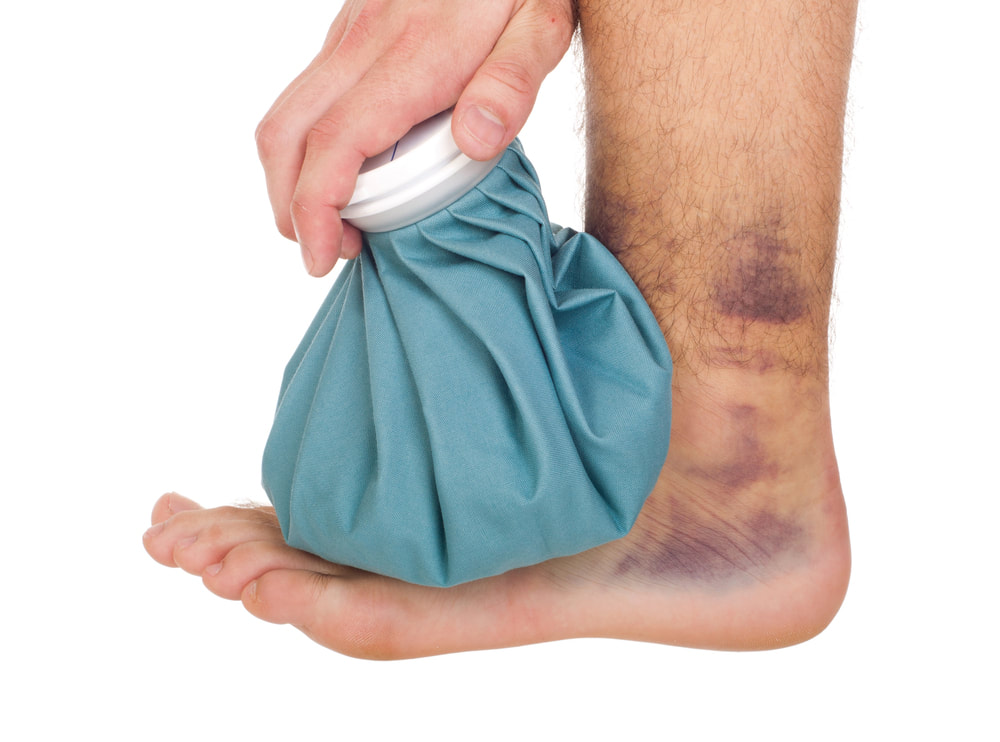
For the sake of discussion, let’s assume we are dealing with a sprained ankle.

​What exactly is a sprained ankle?
A sprain is a trauma to the ligaments by stretching it too far; this causes pain and difficulty with movement. “A mild sprain is really a pulled or strained ligament, with tenderness and mild swelling, but no tearing of tissue. A moderate strain** has partial tearing of the ligament, while a severe strain entails a complete tear, with corresponding degrees of swelling, bruising and inability to move the joint or bear weight” (Hershoff 2000). Conventional treatment involves applying ice to the area and wraps to compress the area. Taber’s also recommends “analgesics and NSAIDs.” As we’ll see below, not all sprains respond well to ice and wraps — another place where homeopathy shines -- We can use those data points to help us find the best suited remedy.

Let’s get back to the simplicity of the over-the-counter pills… How do they work? If you ask an AI, it will tell you that the exact mechanism of acetaminophen (e.g., Tylenol) is not fully understood, but it is believed to work through the central nervous system to block pain signals. Ibuprofen (NSAIDS/Advil), on the other hand, blocks the production of prostaglandins.

What are prostaglandins again?
In simple terms, prostaglandins (PGs) are the chemical messengers that cause pain, swelling, and fever — let’s call that the “alarm system”. In short, Advil turns off the alarm system at the source (blocks the PGs). Tylenol turns the volume down on the alarm sounds in your brain — the alarm is still going, you just don’t “hear” it as loudly, so the pain feels less intense.

Sounds like a solid plan to me! What could be the problem with it?
Taber’s Medical Dictionary (Venes 2017) tells us that prostaglandins (PGs) “influence a broad range of biological effects, including vasodilation, vascular permeability, bronchoconstriction†, platelet aggregation, dysmenorrhea†, inhibition of gastric acid secretion, stimulation of neural receptors for pain during tissue damage, sleep inhibition†, and maintenance of patent ductus arteriosis†.” That sums it all up, doesn’t it?! Keep reading — we’ll see if we can sort some of this out.
  • Vasodilation. If you sprain your ankle, vasodilation is what causes the ankle to swell up and become red, hot and painful. Blocking the vasodilation reduces swelling and makes the ankle less painful. The potential harm of blocking that vasodilation is the vasodilation is actually allowing for your body to call in the repair crew to come in and fix what needs fixing. The OTCs can slow down the healing process — the correct messages aren’t being sent to the fix-it crew.
  • Vascular permeability. This is what causes the swelling (edema), another healing mechanism. As I understand the process, the swelling creates a nice liquid-y environment that allows the healing cells (neutrophils and macrophages) to move around quickly to get their jobs done. Think of it like a walled off watery construction site. If this mechanism is turned off, we risk messing with the essential building blocks (such as fibrinogen and fibronectin), making our imaginary construction site walls temporary, rather than permanent.
  • Platelet aggregation. Kind of important stuff. Let’s assume that when you sprained your ankle, you also got a cut at the same time. Without platelet aggregation, bleeding would continue. Platelets job is to stop the bleeding. Ibuprofen keeps the platelets from doing their thing and is therefore considered a “blood thinner” — but it’s not actually thinning the blood, it’s slowing down the blood clotting mechanism.
    • This would be part of the reason Advil/Motrin has been known to cause gastrointestinal bleeding (especially with prolonged use or for those with a history of peptic ulcers or other bleeding disorders or who take blood thinning medication. If you require an OTC painkiller with any of these conditions, acetiminophen would be a better choice in this instance as it is “a weak inhibitor of platelet cyclooxygenase 1” (Munsterhjelm et al. 2005).
    • “NSAIDs induce clinically significant ulceration, bleeding, and/or obstruction in 1-4% of patients chronically taking these drugs. Even higher rates of ulceration are seen in patients with a history of peptic ulceration; in patients concurrently taking anticoagulants, low-dose aspirin, or glucocorticoids; and in the elderly” (Wallace 2008).
      • 1-4% doesn’t sound like a big deal, but there was a mom on the playground once upon a time who was “bleeding out” due to NSAID use (I was told later). Another mom, who happened to be a doctor, was nearby. If not for her, she probably wouldn’t have made it. This was my first wake up call to an OTC drug I used to use regularly. NSAIDs have also caused GI bleeding in family members - so two close encounters with this stated tiny minority.
    • Inhibition of gastric acid secretion. On the topic of the GI system, NSAIDs can increase gastric acid secretion and harm the stomach lining, too (Wallace 2008). So, the prostaglandins inhibit the gastric acid secretion and the NSAIDs can increase the acid secretion. Tylenol does not have this effect.
  • Stimulation of neural receptors for pain during tissue damage. This is called nociception which is, according to Taber’s (Venes 2017): “The stimulus-response process involving the stimulation of peripheral pain-carrying nerve fibers and the transmission of impulses along peripheral nerves to the central nervous system, where the stimulus is perceived as pain.” By blocking these signals, you are blocking your body’s way of telling you to stop using an injured part so it can heal, potentially causing more damage before you have healed. Tylenol, on the other hand, could be even more harmful as it has not done anything to lessen the inflammation at the injury site, it has just turned down the pain volume.

OK. I get it, OTCs are not completely without risk. What do you suggest using for this fictitious sprained ankle?

Well, homeopathy, of course!
  • Arnica is always a good place to start for any injury. Swelling, bruising, weakness; worse with movement, touch and jarring. Better for cold compresses.
  • For a sprained ankled with redness that feels hot, painful, swollen and stiff and is worse when moving it (or, even incapable of moving it) but feels better from pressure (even tight bandaging) and local heat: Bryonia alba.
  • Rhus tox for pain and stiffness that is worse with the starting of movement but it gets better with continued movement and feels better from applied heat. In other words, the stiffness and soreness are worse from staying in one position too long. Rhus works on ligaments and connective tissue as well as joints.
  • If the affected area feels cold to the touch but also feels better from cold applications/worse for warmth: Ledum palustre. There may be a deep aching.
  • Ruta if it feels tender or bruised and aching — especially good for sprains involving ligaments, tendons and connective tissues. Also good for repetitive strain injuries. May feel worse with cold, damp weather or pressure on the affected area; may feel better for warmth and rubbing.
  • Symphytum is known to aid in healing ligaments and tendons, making it particularly useful in sprains where joint stability is compromised. Particularly good if there is a deep, aching sensation with significant bruising around the sprained area.
  • Bellis perennis for sprains with more bruising and may feel cold (Bellis is sometimes called “the deeper Arnica) — deep-seated soreness; may feel better for warmth and gentle movement. There may be a feeling of constriction as if there were a band around the joint.
Another option… choose two well suited remedies and alternate them. There are a lot of different pieces to a sprain puzzle and these symptoms may change as the healing takes place — move to the next remedy as symptoms change or if the current remedy is no longer as effective.

Or, the combination of Arnica, Ruta and Rhus is an excellent injury go-to, covering many bases at once.

I encourage you to read up on the OTC painkillers. Drugs.com is a good place to start. (Hint: keep scrolling down the page on Drugs.com. There is a brief overview at the top of the page, but if you keep going, you’ll find further links for “side effects” that should be known but are a little hidden.)

If you purchase/make a good household kit, you will be ready to deal with most common ailments that come your way and be able to skirt the OTCs.

Julia Coyte, CHom
Classically Practical homeopath

#wellnessawaits

*Ibuprofen/Advil/Motrin/NSAIDS are used interchangeably throughout this article; likewise acetaminophen/Tylenol, too.

**Some sources say a strain is the injury to tendons while sprains are injuries to ligaments. Other sources use strain and sprain interchangeably.
​
†In keeping with the sprained ankle analogy, bronchoconstriction, dysmenorrhea, sleep inhibition and maintenance of patent ductus arteriosis do not pertain to this situation.

Reference list
American Association of Homeopathic Pharmacists, n.d. FAQs [online]. The American Association of Homeopathic Pharmacists.

Anderson, L. A., 2024. Pain / Fever Drugs and Alcohol Interactions [online]. Drugs.com.

Andonian, N., 2020. Rebound (Medication-Overuse) Headaches: How to Stop Them [online]. GoodRx.

Dimitropoulos, E., 2014. Acetaminophen Toxicity: What Pharmacists Need to Know [online]. Uspharmacist.com.

Durbin, K., 2023a. Acetaminophen [online]. Drugs.com.

Durbin, K., 2023b. Ibuprofen [online]. Drugs.com.

Fine, M., 2013. Quantifying the Impact of NSAID-Associated Adverse Events [online]. AJMC.

Harvard Health Publishing, 2024. Acetaminophen safety: Be cautious but not afraid - Harvard Health [online]. Harvard Health.

Hershoff, A., 2000. Homeopathic Remedies. Kindle. Avery Uuuu-Uuuu.

Mcconnell, T. H., Paulson, V. A. and Valasek, M. A., 2014. The nature of disease : pathology for the health professions. Philadelphia: Wolters Kluwer Health/Lippincott Williams & Wilkins.

Ogilvie, J. D., Rieder, M. J. and Lim, R., 2012. Acetaminophen overdose in children. Canadian Medical Association Journal [online], 184 (13), 1492–1496.

Saljoughian, M., 2016. Acetaminophen Intoxication: A Critical-Care Emergency [online]. Uspharmacist.com.

Venes, D., 2017. Taber’s cyclopedic medical dictionary. Kindle. Philadelphia: F.A. Davis Company.

Waugh, A. and Grant, A., 2023. Ross and Wilson Anatomy and Physiology in Health and Illness. 14th ed. Edinburgh: Elsevier Health Sciences.

Share

11/22/2025

Coinkydink Quickie

Read Now
 
Picture
When one is a homeopath, one sees a lot of [ahem] coincidences.

One evening someone slips and falls and can barely move and they are expecting to need x-rays the following morning and they take a dose of Arnica and coincidentally, they wake up pretty much back to their old self.

A nasty burn on the forearm, and they say — “that’s going to be there for a while.” They take Cantharis and when you see them the next day, they are absolutely amazed that the burn no longer hurts.

Someone ate something off — the resulting gas and tummy pain is bad. They take some Arsenicum album and all those bad things vanished.

A young person scheduled for a tonsillectomy and they take some Silica and they shortly thereafter spit tonsil stones out of their mouth by the spoonful. Surgery cancelled and years later they still have their tonsils.

A young person with frequent, gushing nosebleeds and each time they take the Ferrum phos, the nosebleeds stop (sometimes almost instantly). In fact, not only do they stop when taking the Ferr phos, the following nosebleeds become a little lighter and they show up a little less often.

Surgery is completed and a full schedule of pain meds has been provided (including the big guns, you know what I’m talking about!), and, after taking the first dose of the indicated homeopathic remedies, not one single pain killer has been used.

The dog that is pacing and panting and totally not behaving like his normal self and a few minutes after a dose of Ignatia, he is sleeping peacefully.

All these situations could absolutely be chalked up to coincidence… UNTIL, you see them happen over and over and over again. That’s exactly what you see when you use homeopathy… things that seem too good to be true; things that seem totally coincidental, happening over and over again.

Julia Coyte, CHom
Classically Practical homeopath

​#wellnessawaits

Share

11/14/2025

Congestion

Read Now
 
Picture
Back when I first thought about writing this article (in 2023), decongestants were front and center in the news, just like one’s nose is front and center when it’s all stuffed up. The Consumer Healthcare Products Association suddenly announced that currently available decongestants don’t work. I didn’t dig into all the details because that was another lifetime when I cared about such things.

Back in the day, I was a big fan of Sudafed. I used it very frequently and it really never occurred to me to think there was any reason why I shouldn’t use it. Until one day after years of regular Sudafed use, I had what seemed like, (in hindsight, anyway), a panic attack. At that time, I lived at sea level and I was visiting a high altitude. I took my little red Sudafed, because that’s what I did pretty much every day, and I ended up breathing into a paper bag to calm my system. I have never checked out the side effects of Sudafed until literally right now and, lo' and behold: "fast, pounding or uneven heartbeat" and "severe dizziness or anxiety." It appears (according to Drugs.com) I should have sought medical attention but I didn’t know that at the time. I don’t think I ever had another Sudafed after that miserable experience.

Since finding homeopathy, the thought has honestly never again occurred to me to take any of the allopathic over the counter decongestants.

In the homeopathic literature, the word congestion refers to hyperemia or "an excessive amount of blood in a given part of the body." To look up congestion, as in, “a head filled with snot,” those words would be catarrh and coryza. Old words for colds, basically. From the Oxford Dictionary of English, 2nd edition:
  • Catarrh: excessive discharge or build-up of mucus in the nose or throat, associated with inflammation of the mucus membrane.
    • Taber’s Cyclopedic Medical Dictionary adds, “inflammation of the mucous membranes, esp. of the head and throat.”
  • Coryza: catarrhal inflammation of the mucous membrane in the nose, caused especially by a cold or by hay fever.
    • Taber’s adds, “An acute inflammation of the nasal mucosa accompanied by profuse nasal discharge.”

As you can see by these clear (as mud!) definitions, there is considerable overlap.

For simplicity’s sake, let’s say catarrh is stuffed up (congestion) and coryza is running out. Both problems are associated with colds and allergies which are both causes of congestion. (It's getting circular again!) I suppose one could say it’s better to have it running out rather than being stuck in there, “better out than in!” — but that has its own set of problems.
In an ideal homeopathic world, we would investigate catarrh as it exists in the individual. Where is the congestion located? The eyes, ears, sinus, larynx, trachea, etc.

Were I to begin treating some acute generic catarrh of the cold or allergic derivation (remember, catarrh could be in any part of the body and therefor other remedies may be more appropriate), I would start with either Kali bich or Calc carb.

How would I choose? Well, if it is thick, I’d start with Kali bich. (Did you catch that rhyme there? Very useful to remember.) If the ears are involved to a high degree, I would start with Calc carb. (If we’re talking about a child, I would start with Calc carb because it’s just a good remedy for children, in general.)

For the following symptoms which I gathered from Robin Murphy’s Repertory, both remedies are indicated, but one or the other is generally more indicated.
  • With chills? Calc carb.
  • A tendency to catch colds? Calc carb.
  • Laryngitis or hoarse cough? Kali bich.
  • Dry cough? Calc carb.
  • A dry cough but with copious hawking in the morning? Kali bich.
  • Coughing with mucus in the chest? Kali bich.
  • If the eyes are affected? Calc carb.
  • The mucus is ropy and/or tenacious? Kali bich.
  • With sharp pains? Calc carb.
  • With localized pain in specific spots (think the pain one has with a sinus headache — in the forehead, just above the root of the nose)? Kali bich. (See also, One Little Spot.)
  • Headache bothered by lights or noise? Calc carb.
  • Irritation in the air passages? Kali bich.
  • Mucus in the air passages? Kali bich.
  • Greenish expectoration? Kali bich.
  • Profuse expectoration? Calc carb.
  • With anxiety, depression, fear, apathy or mental slowness? Calc carb.
  • Post nasal drip? Kali bich.
  • Watery discharge? Calc carb.
  • Crusts and scabs inside the nose? Kali bich.
  • Hard, dry nasal discharge? Kali bich.
  • Sinus complaints? Kali bich.
  • Diminished sense of smell? Calc carb.
  • Bad smell in the nose? Kali bich.
  • Bad or sour taste in the mouth? Calc carb.
  • Mucus in the throat, especially if it’s thick or stuck? Kali bich.
  • Sore throat, esp when swallowing? Calc carb.

Let’s sum that list up…
Calcarea Carbonica (Calc carb)
  • Chills, tendency to catch colds, dry cough, profuse expectoration.
  • Eyes affected, sharp pains, headache worsened by lights/noise.
  • Anxiety, depression, fear, apathy, mental slowness.
  • Watery discharge, diminished sense of smell.
  • Bad/sour taste in mouth, sore throat (esp. swallowing).

Kali Bichromicum (Kali bich)
  • Laryngitis, hoarse cough, dry cough with copious morning hawking.
  • Cough with mucus in chest, ropy/tenacious mucus, irritation/mucus in air passages.
  • Greenish expectoration, post-nasal drip.
  • Localized pain (e.g., sinus headache in forehead/root of nose).
  • Crusts/scabs in nose, hard/dry nasal discharge, bad smell in nose.
  • Sinus complaints, mucus in throat (thick/stuck).

It’s important to remember that BOTH Calc carb and Kali bich are indicated in all of these symptoms. What I have highlighted here is when one remedy was MORE indicated in each of these symptoms. (It's also important to remember there are many more remedies indicated in every one of these symptoms. I just chose to focus on the two most highly indicated remedies for catarrh, in general.)

As a rule of thumb for an acute situation, choose one remedy and try a few doses. For example, take a dose of your chosen remedy in a 30c, approximately every 15-20 minutes for one hour. If there is ANY improvement, stick with that remedy. If there is NO improvement (I mean none!) then try a few doses in the same manner of the other remedy.
For further ideas on dealing with colds and congestion, see: “Cough cough!” ; “Tis the Season for the Crud”; “Her Ears were Yuck”; “Calming the Cold”; "Allergies are Back".

Forget trying to figure out which over the counter decongestants may or may not work and try some homeopathy. Homeopathy has no side effects. Homeopathy doesn’t interfere with other medicines. Homeopathy is not addictive.

Julia Coyte, CHom
Classically Practical homeopath

#wellnessawaits

Share

11/7/2025

Quickie: Narayani Traveling 10

Read Now
 
Picture
I have written before about how much I like traveling with my Narayani kit. That 50 remedy kit might be a little big & spendy for some people’s liking. I was recently asked which Narayani remedies I would recommend for traveling so I thought I would give a quick rundown of my top 10. This is just a general list — these choices won’t suit everyone. These were chosen from the top 50 kit, not from the entire Narayani line up. All descriptions excerpted from Helios’ Narayani book.

1. Allergy Balance mix 62
  • Management of all allergic conditions of the skin, nasal, mucus membranes and chest.

2. Calming mix 6
  • They calm the entire system, mentally and physically.
  • For busy parents whose children have challenging behavior.
  • Tense business professionals.
  • Any grieving family.
  • Any condition of stress or apprehension.

3. Colds mix 11
  • Watery discharge from nose and eyes; sneezing.
  • The moment a cold is beginning start with this mix.

4. Constipation mix 13
  • Although giving a remedy for constipation is allopathic in approach, this combination has worked well in practice for this very common [travel] problem.

5. Drawing mix 16
  • All morbid conditions — holds infection, draws.
  • Any morbid matter to be pulled out of the body will react to Drawing mix 16, be it mucus in the sinus, tonsils, ears, uterus or rectum.
  • Its work in bringing to maturity boils and carbuncles and draining fissures and putrid leg ulcers, no matter of how long standing, has to be seen to be believed.

6. Flu pack mix 79
  • For fever, chest, lungs and muscles.
  • Use as a preventative.

7. Gastro mix 80
  • To be used in all acute infections and inflammations of the gastric tract, food poisoning, vomiting, colic with fever, dysentery, etc.
  • For anyone having influenza which attacks the digestive system with cramps, pains, nausea and vomiting with a fever, this remedy is excellent.

8. Injury mix 20
  • Muscles, nerves, ligaments, cartilage wounds, all injuries, after surgery, hemorrhage, overstrain.
  • To be used for all types of injuries — those of long standing or an acute, recent injury.

9. Skin (dryness) mix 101
  • Mainly for a dry and cracked hand condition, but can be used for dry skin anywhere on the body.

10. Stings & Bites mix 103
  • Use for any insect bites or stings and any animal stings or bites.

I have to confess, I can’t believe it took me so long to come up with this simple plan, but I love it! I recently purchased empty 1/2 dram vials and I dispense from my 2 dram tubes and stick a little label on there and voilà, I have my own little individualized kit. Perfect!

Happy Travels!

Julia Coyte, CHom
Classically Practical homeopath

​#wellnessawaits


Share

10/31/2025

Pre-Winter Bugs

Read Now
 
Picture
Here they are again, just like clockwork!

​My phone is abuzz with colds and headaches and snot. I guess it’s that time of year again and following close on the heels of the colds, you know what’s next… 

​The bugs tried to hit my house in the last week or so, too and, so far we have beaten them back. Historically, the go-to in our house is either Cold Calm (my husband’s favorite) or, the Banerji Protocol of Aconite + Bryonia. (See also, Ho Ho Ho; When you Have to Get Up; Digging Deeper into the Flu remedies #1 & #2 and Ahh-Choo!)

​I have recently added another remedy to my line-up of homeopathic considerations when things are going south… Narayani Flu Pack, mix 79.
Narayani Flu Pack pretty much leaves no stone unturned being a combination of 4 other Narayani combinations, plus a single remedy, too.

“That’s a lot of remedies,” you say?
“Yes, it is,” I answer.

“What are you thinking taking so many remedies?”
I think I am putting these nasty viruses back where they belong — outside my body!

You see, homeopathy is pretty intelligent stuff. If your body doesn’t need it — if your body doesn’t resonate with a remedy, it will just put it aside and not bother with it. To clarify, if one repeatedly keeps taking a remedy that one does not require, it can cause the symptoms it is otherwise supposed to quell, also known as a “proving”. (See also, The Original Drug Testing… Homeopathic Provings.)

“How would one know which remedy to try? You have listed an awful lot of choices!”
You are correct. There is hardly ever just one right answer when it comes to which homeopathic remedy to take. Many homeopathic remedies share overlapping symptoms with many other remedies. In an, ideal, classical homeopathic world, a professional homeopath could take your case and decide which single remedy would best serve. I don’t know about you, but when I’m feeling crummy, I want answers ASAP. In short, in this case, the remedy that is nearest is most appropriate because time is of the essence — We want to nip this in the bud so it can’t take hold.

Here is how I would consider these remedies.
  • If I felt pretty certain that my symptoms were just of the run of the mill cold variety, (other family members or close friends have cold symptoms and it didn’t progress from there) I would definitely begin with Cold Calm. It has rarely failed me.
  • If I’m out and about and feel a little something coming on, I would reach in my purse and take a dose of Aconite & Bryonia because that is what would be handy.
  • If I feel like maybe I didn’t get to addressing things fast enough, that is when I would consider Narayani Flu Pack.

“Alright then, I’ll bite — tell me more about this Flu Pack.”
Narayani remedies were created to address practical healthcare challenges in resource-limited settings, particularly in India and South Africa. As the story goes, they didn’t expect to be able to see their otherwise rural patients again too soon, so they loaded them up with remedies, particularly combination formulas for specific ailments. They’ve been in use for over 50 years, so there must be something worth looking into here. I know I have yet to be disappointed with any I have tried. (See also, The Narayani Kit.)

So, let’s break down the Flu Pack and see what is included…
Helios’ The Narayani Combination Remedies guide tells us the Flu Pack is “for fever, chest, lungs and muscles.”

Breakdown:
Chest, Cough & Asthma (mix 71) to “deal with the chest and lungs; whole body aching in bones and flesh.”

Eupatorium perfolatum: “chest sore, patient must support it; nausea; vomiting bile.” Eupatorium perfolatum is a personal favorite of mine. I love this stuff for when the aches and the fatigue are both really heavy.

Fever & Infection Balance (BR10) & General Fever (mix 18): “these deal with the fever by holding it (not lowering it), so that it may burn out the virus; it must be remembered that no virus can be killed by any drug; it can only be burnt out by the fever produced by the body.”

War (mix 35): “to hold the infection, preventing it from spreading through the body, and to deal with it.”

Take a dose as soon as one feels flu is coming on and see what you think.
I think you might just be pleasantly surprised.

Here’s to keeping the yucks at bay this year!

Julia Coyte, CHom
Classically Practical homeopath

#wellnessawaits

Share

10/24/2025

Quickie: Narayani Books

Read Now
 
Picture
A Ruminating on Remedies reader (who had read The Narayani Kit) emailed the other day asking about the books mentioned in that article. That email prompted this brief breakdown of the available Narayani books.

Bear in mind, all of these books all have the same basic information. The Narayani Remedies are what they are and I don’t think they are going to change any time soon.

The first book I purchased was edited by Robert Davidson. It has ~100 pages and is the most basic option. Thinking back, there was something missing in this book for me to go off and find other options. I can’t elaborate, but it didn’t feel complete. Amazon shows this selling for $59.99.
  • A-Z listing of all the remedies.

Nimisha Parekh’s book followed Davidson in my collection. At ~130 pages, this has much more information. Amazon shows this selling for $48, but the price listed on the book is $60. Narayaniremedies.com sells it for $39.95. Taproots sells it for $49.99. Nimisha Parekh also runs webinars on the Narayani Remedies and I believe she works directly with narayaniremedies.com.
  • This one gives more basic information at the beginning, specifically, describing the 8 remedy groups. ex. “The 117 mixtures are mainly combinations of homeopathic remedies and Gem or Bach remedies. Their potency range is 3x to 50M.” She breaks down what each of the remedy groups are.
    • Includes:
      • A-Z listing of all the same information found in Davidson’s book.
      • Chakra Healing information
      • Gem Colour Healing
      • Meridien Remedies
      • The New 44 Crystal Remedies
      • Omkar Remedies
      • Five Elements
      • Cranial Nerves
      • Single Organ Remedies
      • Therapeutic Index
      • Plus, a mini book tucked into the back cover with Addendum (useful combinations) + Thymus Gland Combination Remedies

Helios (~123 pages) was my third addition and I was sold when reading the description saying it was “updated and revised.” (“Cleaned up” might be a better description, though; it’s a neat, tidy and smaller edition.) Available at Helios for £9.95.
  • The preface says it is “a reworking of the original ‘Soham Series of Natural Healing Volume 3,’ by Swami Narayani… It also acknowledges Robert Davidson’s ‘Materia Medica’ [first book listed above]… a much needed opportunity to correct some errors in both numbering and potency that have crept in over time in the printed documentation.… modernized the more archaic language from the original… some of the remedy names have been updated so they are clearer to identify and differentiate. The indexes have also been re-worked in order to make it easier to search for remedies and each entry has now been cross-referenced so navigation through the text is simpler.”

Swami Narayani’s Soham Series of Natural Healing, Volume 3. I felt the need to see what I was missing in other people’s interpretation. Turns out it’s not much**; the others did a good job compiling the information. Plus, I find this version doesn’t flow as nicely visually and it is laid out numerically, not alphabetically. (The other 3 list “Acidity Mix 37” first and this one lists Mix 1 Amoebic Dysentery first.) It does, however, offer rates, so if that’s your thing, here they are.

​What do all three books share? Almost everything:
  • A-Z directory of remedies with pretty much identical information. (Any differences I found are not relevant, except Parekh’s extended information which I find helpful.)
  • Using the first entry in all three books, The Acidity mix 37, the information is identical between 1 & 2 (with the exception of what has been singled out as bold type — Davidson bolds the conditions in the body and Parekh bolds which remedies can be used in conjunction with it). The Helios copy has removed the bold type and italicized the mix names and added their specific combo (e.g. Liver Mix 22 or Liver Balance BR12) with which the Acidity Mix can be combined.
    • This inclusion of the specific remedies is actually helpful. There are 3 different “Liver” combos and there are 3 different “Digestion” combos. Not a huge deal, but it does make it easier and faster.
  • They are each spiral bound. (Narayani’s Soham Series of Natural Healing, volume 3 is not.)
  • “Therapeutic Guide” pages at the back of each. There are a couple of differences here, primarily in how they are laid out.
    • Davidson has “A Small Therapeutic Guide” listing 11 “conditions” and then lists: “Parts/Organs; Sensory; Allergy; Psycho-Spiritual Combinations; General Diseases and Other Diseases.”
    • Helios has “A Concise Therapeutic Guide” listing the same 11 “conditions” and then: “Parts/Organs; Sensory; Allergy; Psycho-Spiritual Combinations.” However, Helios has a few different combinations mentioned under some of these headings.
      • “Immunity,” Davidson lists 4, Helios lists 5.
      • “Trauma/Fear,” Davidson lists 4, Helios lists 6.
    • Parekh’s “Therapeutic Index” is laid out differently.
      • For instance, “Immunity” is not listed and all the “Trauma/fear” remedies are under “Mind” but it also includes “Exam Nerves” separately. This is one very minor area where Parekh’s book falls short.
  • A few of the remedies have different names. e.g., Mix 117, according to Narayani, (and Davidson and Parekh), is “Anti-Smoking Remedy.” Helios calls it “Smoking (Cessation)”.

​Which one to buy?
For the money, Helios wins that one hands down. Yes, it has to ship from the UK, but you know you need to purchase a few remedies from them anyway — making the whole thing worth it!

From the information standpoint, Nimisha Parekh provides the most and this is info that is not readily available elsewhere.

The Helios book is the most clearly written (and smallest). But, I like the Nimisha Parekh copy, too — more information.

I hope that helps. I’ll be back soon with some more Narayani info.

Julia Coyte, CHom
Classically Practical homeopath

#wellness awaits

​*All prices are valid at the time of this writing.
*I have no affiliation with any authors or shops or websites listed.
**Full disclosure, I have only skimmed through Swami Narayani’s books and I have yet to comb through to see if there are any nuggets that speak to me which the other gatherers of this information didn’t choose to highlight. If I come up with any, I’ll let you know!

Share

<<Previous
Forward>>
Details

    Archives

    October 2026
    September 2026
    August 2026
    July 2026
    June 2026
    May 2026
    April 2026
    March 2026
    February 2026
    January 2026
    December 2025
    November 2025
    October 2025
    September 2025
    August 2025
    July 2025
    June 2025
    May 2025
    April 2025
    March 2025
    February 2025
    January 2025
    December 2024
    November 2024
    October 2024
    September 2024
    July 2024
    June 2024
    May 2024
    April 2024
    March 2024
    February 2024
    January 2024
    December 2023
    November 2023
    October 2023
    September 2023
    August 2023
    July 2023
    June 2023
    May 2023
    April 2023
    March 2023
    February 2023
    January 2023
    December 2022
    November 2022
    October 2022
    September 2022
    August 2022
    July 2022
    June 2022
    May 2022
    April 2022
    March 2022
    February 2022
    January 2022
    December 2021
    November 2021
    October 2021
    September 2021
    August 2021
    July 2021

    Picture
    Julia Coyte is a classically trained homeopath who is well versed in the practical application of homeopathic remedies.
    ​
    To arrange for a consultation, click here.

    RSS Feed

    Categories

    All
    AAA
    Abrus Precatorius
    Abscess
    Abuse
    Accident
    Acetaminophen
    Ache
    Aches
    Acidity
    Acne
    Aconite
    Aconite Bryonia
    Aconitum Napellus
    Activated Charcoal
    Acupuncture
    Acute
    Acute Consultation
    Acute Sickness
    Advil
    Aesculus
    Aggravation
    Aging
    Ainsworth
    Air Sick
    Alcohol
    Allergic Reaction
    Allergies
    Allergy
    Allium Cepa
    Aloe
    Alopecia
    Altitude
    Alumina
    Alzheimer's Disease
    Ambra Grisea
    Ammonium Carbonicum
    Amputation
    Anacardium
    Anal Fissure
    Anal Fistulae
    Anaphylactic
    Anaphylaxis
    Anas Barbarie
    Anemia
    Anesthesia
    Anger
    Animals
    Ankle
    Annoyed
    Antacid
    Anticipatory Anxiety
    Antidote
    Antimonium Crud
    Antimonium Tart
    Anxiety
    Aphorism
    Aphthae
    Aphthous Stomatitis
    Apis
    Apis Mellifica
    Appendectomy
    Apps
    Aregentum Nitricum
    Argentum Nitricum
    Arnica
    Arsen
    Arsenicum Album
    Arthritis
    Aspen
    Asphyxia
    Asteraceae
    Asthma
    Aurum
    Aurum Metallicum
    Auto-immune
    Avena Sativa
    Azadirachta Indica
    Bach Flower Remedies
    Bach Rescue Remedy
    Back
    Back Ache
    Back To School
    Balance
    Bambusa
    Banerji Protocol
    Banerji Protocols
    Baptisia
    Baptisia Tinctoria
    Bashful
    Bedsore
    Bee
    Bee Sting
    Belladona
    Belladonna
    Bellis Perennis
    Betrayal
    BHI
    Bicycle Fall
    Bioplasma
    Bird Flu
    Bites
    Bite Tongue
    Blackhead
    Bleeding
    Bleeding Nose
    Blisters
    Bloating
    Blocked Eustachian Tubes
    Blood
    Blood Vessels
    Bloody Nose
    Body Aches
    Boils
    Boiron
    Boiron's Chestal Cold & Cough
    Bone
    Bone Spurs
    Boogers
    Book Review
    Books
    Borax
    Bordatella
    Bowel Habits
    Brain Fatigue
    Brain Fog
    Brainfog
    Breast Feeding
    Breathing
    Bristol Stool Form Scale
    Broken Bones
    Broken Heart
    Bronchitis
    Bruise
    Bruising
    Bryonia
    Bug Bites
    Bunions
    Burn
    Burning Eyes
    Burning Pains
    Burning Sensation
    Burning Urination
    Burns
    Burp
    Bursitis
    Caffeine
    Caladium
    Calc Carb
    Calc Fluor
    Calc Phos
    Calc Sulph
    Calendula
    Camphor
    Camphora
    Candy
    Canker Sore
    Canker Sores
    Cantharis
    Capsaicin
    Carbo Veg
    Carbo Vegetabilis
    Car Sick
    Cartilage
    Cataract
    Catarrh
    Caterpillar
    Cattle
    Causticum
    Cavities
    Cavity
    Cell Salt
    Cell Salts
    Centipede
    Cercarial Dermatitis
    Chamomilla
    Chapped Lips
    Charcoal
    Chelidonium
    Cherry Plum
    Chicken
    Chickens
    Chicory
    Chilblains
    Childbirth
    Children
    China
    China Officinalis
    Chiropractic
    Chlorine
    Chocolate
    Cholera
    Cimicifuga
    Cinchona
    Cinchona Officinales
    Claustrophobia
    Clematis
    Coca
    Cocculus
    Cocculus Indicus
    Coffea
    Coffea Cruda
    Coffee
    Cold
    Cold Calm
    Coldness
    Colds
    Cold Sores
    Cold Weather
    Colic
    Collagen
    Collapse
    College
    Collinsonia
    Colocynthis
    Combination
    Combination Remedies
    Comedone
    Comfrey
    Concentration
    Concussion
    Congestion
    Conium
    Conium Maculatum
    Conjunctivitis
    Connective Tissue
    Constipation
    Control
    Contusion
    Convalescence
    Convalescense
    Cookies
    Corneal Abrasion
    Coryza
    Cough
    Coughing
    Courage
    Covid
    Crab Apple
    Cracked Skin
    Cracks
    Cradle Cap
    Cramp
    Cramps
    Craniosacral Therapy
    Crotalus Horridus
    Croup
    Crush Injury
    Cst
    Cuprum Metallicum
    Cut
    Cuts
    Cystitis
    Dandelions
    Dandruff
    Daylight Savings Time
    Death
    Decongestant
    Dehydration
    Dementia
    Dental
    Dental Pain
    Dentist
    Dentistry
    Depression
    Diarrhea
    Digestive Supplements
    Dilution
    Dioscorea
    Disappointment
    Distraction
    Distrubed
    Dizziness
    Dizzy
    Dog
    Dogs
    Dorothy-shepherd
    Dose
    Dosing
    Dread
    Drosera
    Dry Mouth
    Dry Skin
    Dulcamara
    Dulcamera
    Ear Ache
    Ear Aches
    Ear Infection
    Ear Infection Research
    Ear Infections
    Ear Pain
    Ears
    Echinacea
    Eczema
    Edema
    Effort
    Elderly
    Elm
    Emergency
    Emotions
    Epistaxis
    Equisetum
    Eupatorium
    Eupatorium Perfolatum
    Eupatorium Perfoliatum
    Euphrasia
    Exams
    Excitement
    Exhaustion
    Exostosis
    Extravasation
    Eyeball
    Eyes
    Eye Strain
    Fainting
    Fall
    Falling
    Fart
    Fascia
    Fatigue
    Fear
    Ferr Phos
    Ferrum Phos
    Fever
    Fever Blisters
    Fibonacci
    Finger
    Fireworks
    First Aid
    First Aid Kit
    Flatulence
    Flatus
    Flu
    Flying
    Foodborne Illness
    Food Poisoning
    Foot
    Foot Cramp
    Foot Pain
    Forest Fire
    Fowl
    Fracture
    Frenectomy
    Fright
    Frostbite
    Frostnip
    Gallstones
    Ganglion Cysts
    Gas
    Gastro
    Gelsemium
    Gelsemium Sempervirens
    Gemmotherapy
    Geographic Tongue
    Glonoinum
    Graphites
    Grief
    Guilt
    Gunpowder
    Gut
    Hahnemann
    Hair Loss
    Hallucinations
    Hamamelis
    Hamamelis Virginiana
    Hamstring
    Hands
    Hangover
    Happiness
    Hay Fever
    Hayfever
    Head
    Headache
    Head Colds
    Head Injury
    Health Timeline
    Hearing
    Heart Attack
    Heartburn
    Heat Exhaustion
    Heat Prostration
    Heat Stroke
    Hecla Lava
    Heel Pain
    Heel Spurs
    Heights
    Hekla Lava
    Helios
    Hemlock
    Hemorrhage
    Hemorrhoid
    Hemorrhoids
    Hepar Sulph
    Herbs
    Herd
    Hiccups
    Hip
    Hives
    Hoarseness
    Hoarse Voice
    Holiday
    Holly
    Homeochords
    Homeoopathy Podcast
    Homeopathic
    Homeopathic Books
    Homeopathic Chords
    Homeopathic Consultations
    Homeopathic Dosing
    Homeopathic Kit
    Homeopathic Language
    Homeopathic Podcasts
    Homeopathic Potency
    Homeopathic Remedies
    Homeopathic Remedy
    Homeopathic Software
    Homeopathy
    Homeopathy Books
    Homeopathy Classes
    Homeopathy Explained
    Homeopathy History
    Homeopathy Links
    Homeopathy Research
    HomeoSource
    Homesick
    Honeysuckle
    Hornbeam
    How-to
    Humiliation
    Humulus (Lupulus)
    Hydrastic Canadensis
    Hydrastis
    Hyper/ars
    Hypericum
    Hypericum Perforatum
    Hypothermia
    Hysteria
    Ibuprofen
    Icthammol
    Ignatia
    Illness
    Immune System
    Impatiens
    Impetigo
    Indigestion
    Infant
    Infection
    Inflamed Gums
    Inflammation
    Influenza
    Ingrown-toenail
    Injection
    Injure
    Injuries
    Injury
    Insect Bite
    Insect Bites
    Insomnia
    Intrusive Thoughts
    Involuntary
    Ipecac
    Irritability
    Irritated
    Irritation
    Isopathy
    Itching
    Itching Eyes
    Jealousy
    Jellyfish
    Jequirity
    Jet Lag
    Jimson Weed
    Joint
    Joint Pain
    Joint Pains
    Joints
    Kali Bich
    Kali Carb
    Kali-carb
    Kali Mur
    Kali Nit
    Kali Phos
    Kali Sulph
    Keeping Notes
    Kennel Cough
    Kidney
    Kidney Stones
    Kids
    Kit
    Knee Pain
    Knife
    Knife Wound
    Laceration
    Lachesis
    Lactic Acid
    Lacticum Acidum
    Ladder
    Ladybird
    Ladybug
    Larch
    Laryngitis
    Ledum
    Ledum Palustre
    Leg
    Lienteric Stool
    Ligament
    Lightning
    Lightning-like Pain
    Like Cures Like
    Lithotripsy
    Liver
    Loneliness
    Lonely
    Low Grade Fever
    Lyco/ars
    Lycopodium
    Lyme Disease
    Magnesium Phos
    Mag Phos
    Malaise
    Mapped Tongue
    Massage
    Materia Medica
    Measles
    Melatonin
    Memories
    Memory
    Menopause
    Menses
    Men's Health
    Menstrual Cramps
    Mental Shock
    Mercurius Sol
    Mezereum
    Miasm
    Miasms
    Migraine
    Millefolium
    Mimulus
    Minor Burns
    Mint
    Mold
    Moodiness
    Mood Swings
    Morning Sickness
    Mosquito
    Motion Sick
    Motion Sickness
    Mouse
    Mouth
    Mucous Membranes
    Mucus
    Muscles
    Music
    Mustard
    Myofunctional Therapy
    Nanoparticles
    Narayani Flu
    Narayani Flu Pack
    Narayani Remedies
    Narcosis
    Nat Mur
    Nat Phos
    Natrum Carb
    Natrum Muriaticum
    Natrum Phosphoricum
    Nat Sulph
    Nat-sulph
    Nausea
    Neck
    Nerve
    Nerve Pain
    Nerves
    Neuralgia
    Never Well Since
    News
    Nightmare
    Night Terror
    Nitric Acid
    Noise
    Noises
    Norovirus
    Norwalk Virus
    Nose
    Nose Bleed
    Nosode
    Nosodes
    NSAIDs
    Numb
    Numbness
    Nux Moschata
    Nux Vomica
    NWS
    Oak
    Olive
    Ollois
    Oral Health
    Organon Of Medicine
    Oscillococcinum
    Osteoarthritis
    Over-eating
    Over-exertion
    Overexertion
    Over Indulgence
    Over-indulgence
    Overwhelm
    Overwork
    Oxygen
    Paeonia
    Pain
    Pain Descriptions
    Painful
    Painful Skin
    Pain Relief
    Palatal Expanders
    Pandemic
    Panic
    Panic Attack
    Passiflora
    Peacock
    Perfectionism
    Perforated Eardrum
    Performance
    Perimenopause
    Perineum
    Perspiration
    Petroleum
    Pets
    Phantom Pains
    Pharyngitis
    Phosphoric Acid
    Phosphoricum Acidum
    Phosphorus
    Phosporic-acid
    Photophobia
    Phytolacca
    Phytolacca-decandra
    Picric Acid
    Pigs
    Piles
    Pine
    Pink Eye
    Plantago
    Plantago-major
    Plantain
    Plantar-fasciitis
    Plantar-fasciitis
    Platina
    Plumbum
    PMS
    Podophyllum
    Poison
    Poison Ivy
    Pomegranate
    Pool
    Poop
    Potency
    Potentization
    Poultry
    Prid-drawing-salve
    Prolapse
    Provings
    Psora
    Psoriasis
    Ptsd
    Pulsatilla
    Puncture-wound
    Purchase
    Purchasing Remedies
    Pus
    Quality-of-life
    Questions
    Rage
    Rash
    Ratanhia
    Raynauds
    ReBoost
    Recipe
    Recovery
    Recuperation
    Red-ant-bite
    Red-chestnut
    Regret
    Remedy Kit
    Remedy Kits
    Renal
    Repertory
    Repetition
    Rescue-remedy
    Research
    Restlessness
    Rheumatic
    Rheumatism
    Rhus Tox
    Ribs
    Ringworm
    Road-rash
    Rolf
    Rubric
    Rubrics
    Runny-nose
    Runny-nose
    Ruta
    Ruta-grav
    Ruta-graveleons
    Ruts
    Sacrum-pain
    Sadness
    Samuel Hahnemann
    Sanguinaria
    Sarcode
    Sarcodes
    Scald
    Scar
    Scars
    Schmukler
    School
    Schussler
    Schussler-tissue-salts
    Sciatica
    Science
    Screaming
    Seasick
    Sensitive
    Sepia
    Sepsis
    Shame
    Shivers
    Shock
    Shooting-pain
    Side-effects
    Silica
    Silicea
    Sinus
    Sinus-headache
    Sinus-headache
    Sinusitis
    Sinus-pain
    Sinus-pain
    Skinned-knee
    Sleep
    Sleeplessness
    Smelling Salts
    Smoke
    Smoke Inhalation
    Sneeze
    Sneezing
    Snot
    Sol
    Solar Eclipse
    Sore
    Sore Muscles
    Sores
    Sore Throat
    Sorrow
    Sour
    Spasm
    Spigelia
    Splinter
    Spongia Tosta
    Sprain
    Sprains
    Stage Fright
    Stagnant Emotion
    Staphysagria
    Sticta
    Stiff Neck
    Stimulation
    Sting
    Stings
    Stitches
    Stomach Cramps
    Stomach Flu
    Stomach Pain
    Stool
    Stools
    Strain
    Stramonium
    Strep Throat
    Stress
    Stretching A Remedy
    Studying
    Stuffy Nose
    Sugar
    Sulphur
    Sulphur Iodatum
    Sumbul
    Sunburn
    Sunstroke
    Suppressed Anger
    Surgery
    Surgical Wounds
    Swelling
    Swimmer's Ear
    Swimming
    Swollen Glands
    Sycosis
    Symphytum
    Syncope
    Syphilitic
    Tabacum
    Tailbone
    Tarantula
    Taraxacum
    Tarentula Hispanica
    Taste And Smell
    Teeth
    Teething
    Temper Tantrum
    Tendon
    Tendons
    Terror
    Thanksgiving
    Thermal Shock
    Thiosinaminum
    Thoughts
    Throat
    Throat Tickle
    Thuja
    Thyroid
    Thyroidinum
    Ticks
    Tiger Balm
    Timid
    Tincture
    Tingle
    Tinnitus
    Tissue Salts
    Toe
    Tongue
    Tongue Tie
    Tonsil
    Tonsilitis
    Tonsillectomy
    Tonsillitis
    Tonsillolith
    Tonsils
    Tonsil Stone
    Tooth
    Toothache
    Tooth Decay
    Trauma
    Traumatic Brain Injury
    Traumeel
    Travel
    Traveler's Diarrhea
    Travel Sick
    T-Relief
    Trembling
    Trituration
    Tummy
    Tummy Bug
    Tylenol
    Ulcer
    Unconscious
    Unrequited Love
    Urgent
    Urinary Tract Infection
    Urtica Urens
    UTI
    Utica Urens
    Vaccination
    Valeriana
    Varicose Veins
    Veratrum Album
    Vertigo
    Veterans
    Veterinary
    Violent
    Vomiting
    Walnut
    Wasp Sting
    Water Dose
    Weakness
    Wedding
    White Chestnut
    Whitehead
    Wild Fires
    Wild Rose
    Wind
    Winter
    Work
    Worr
    Worry
    Wound
    Wounds
    Wrist
    Wyethia
    Xray
    Yeast Infection
    Yuzu

  • Home
  • In a nutshell …
    • Classical? Practical?
  • About
    • contact >
      • FAQ
  • Blog
  • Book appt
    • Before first appt >
      • Choosing a homeopath
      • Useful info >
        • References & Resources
  • Research
  • Product